Can Your Company Settle Tax Debt? Offer in Compromise for Business Explained
How an Offer in Compromise for business settles IRS back taxes for less — eligibility rules, Reasonable Collection Potential, Form 433-B (OIC), payment terms, and state vs. federal compromise differences.

Katherine M. Johnson, CPA, CTRS
Lead Tax Resolution CPA
Yes, a business can settle IRS tax debt through an Offer in Compromise when its Reasonable Collection Potential is less than the balance owed. The IRS evaluates business assets, cash flow, and future ability to pay using Form 433-B (OIC) and Form 656, and requires full filing and deposit compliance first. Your offer generally must be at least as much as the IRS reasonably expects it could collect before the 10-year collection statute expires.
A qualifying offer in compromise for business can let your company settle IRS tax debt for less than the full balance when paying in full is not realistic. The key is to first get compliant: file required returns, make current estimated tax payments, stay current on payroll tax deposits if you have employees, and confirm the business is not in an open bankruptcy.
# How an Offer in Compromise for business can settle back taxes
A qualifying offer in compromise for business can let your company settle IRS tax debt for less than the full balance when paying in full is not realistic. The key is to first get compliant: file required returns, make current estimated tax payments, stay current on payroll tax deposits if you have employees, and confirm the business is not in an open bankruptcy.
The IRS does not approve an offer simply because a business has a large tax bill. It reviews business assets, cash flow, expenses, and future ability to pay. Your offer generally must be at least as much as the IRS reasonably expects it could collect.
If liens, levies, or payroll tax debt are putting pressure on your business, an Offer in Compromise may be worth exploring — but only after a careful financial review. A weak or incomplete application can be returned, rejected, or leave you with payments and fees that are not refunded.

Critical CPA Takeaway
I am Katherine Johnson, and I bring more than 30 years of accounting, tax planning, and financial-resolution experience to helping business owners assess an offer in compromise for business. At Next Level Tax Resolution, Inc., we help clients understand their records, options, and the steps needed to pursue a workable tax-debt solution.
# Eligibility rules for an Offer in Compromise for business
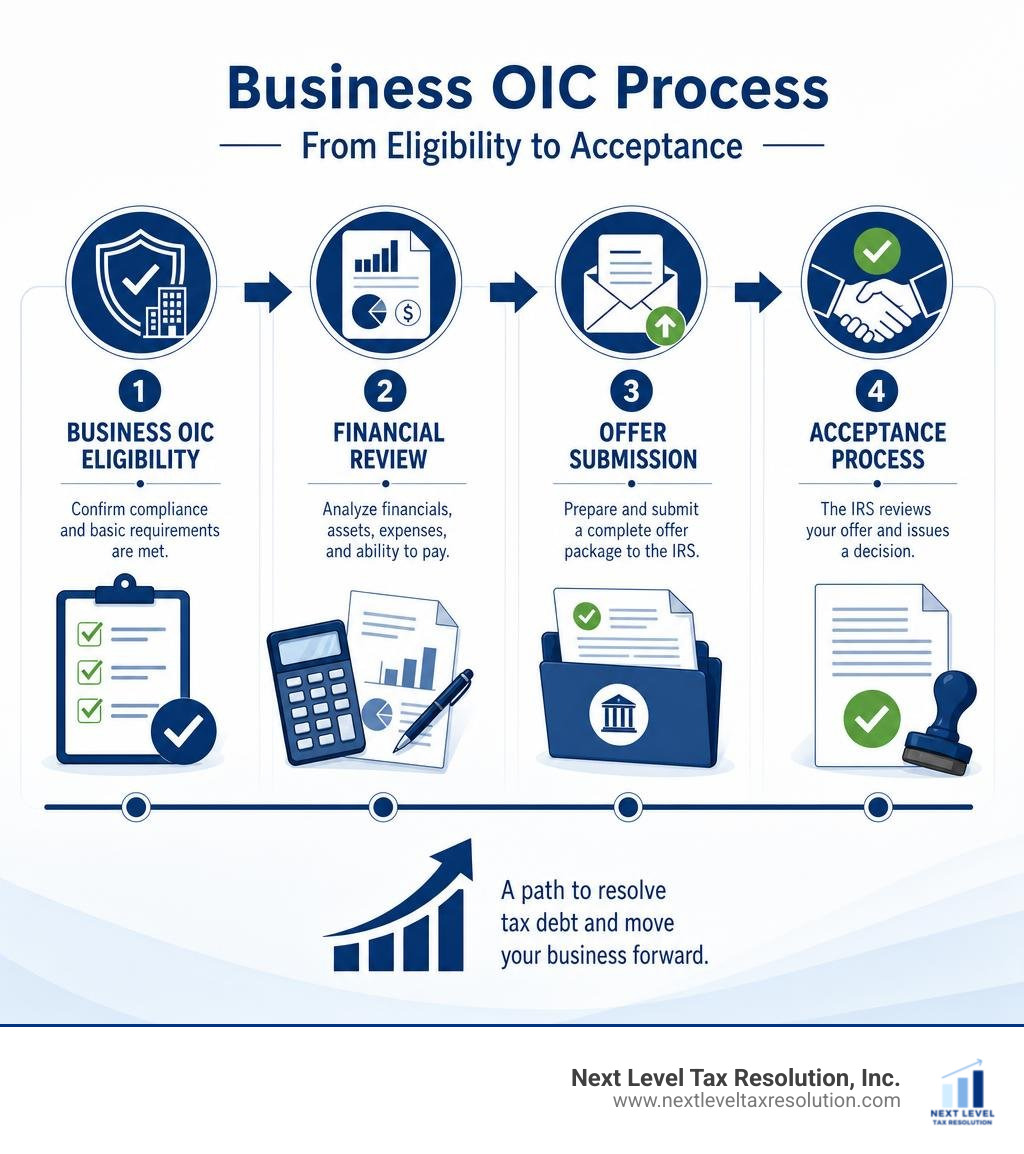
Securing a formal settlement through an Offer in Compromise is one of the most powerful tax relief tools available, but it requires meeting stringent administrative and statutory rules. The IRS evaluates business compromises primarily under the standard of Doubt as to Collectibility — meaning your business's assets and future projected earnings are legally insufficient to pay off the balance within the statutory collection period.
Before the IRS will even assign an examiner to look at your financial books, your company must pass threshold processability checks. An IRS Chief Counsel legal memorandum on in-business tax delinquency highlights that while initial administrative processing rules differ between individual taxpayers and active corporate entities, the agency maintains broad discretion to reject compromises on their merits if ongoing non-compliance suggests bad faith.
Facing This Exact IRS Situation?
Don't speak with an automated call center or non-licensed salesperson. Speak directly with Katherine M. Johnson, CPA, CTRS.
# Which entities can file an Offer in Compromise for business?
Almost any business structure can seek relief, but the paperwork, liability walls, and review procedures vary significantly depending on your entity classification. Navigating comprehensive Tax Debt Resolution requires matching the application strictly to your legal structure:
- Sole Proprietorships: Because sole proprietorships are not distinct legal entities apart from their owners, business liabilities are tied directly to your Social Security Number (SSN). You apply using individual forms (Form 433-A (OIC) and Form 656), combining both business and personal income and assets.
- Partnerships: Operating partnerships submit Form 433-B (OIC) to settle entity-level tax assessments. However, general partners remain individually liable for underlying partnership debts if the entity fails to satisfy them.
- C-Corporations and S-Corporations: Corporate entities are separate legal taxable entities. Corporate income, assets, liabilities, and retained earnings are evaluated on Form 433-B (OIC). The settlement resolves only the corporation's designated tax liabilities.
- Limited Liability Companies (LLCs): Single-member LLCs taxed as disregarded entities typically file under individual forms for income tax issues, whereas multi-member LLCs or LLCs taxed as corporations file using corporate business forms.
# Non-negotiable compliance and bankruptcy thresholds
The IRS rejects an OIC submission immediately — keeping your non-refundable application fee — if basic compliance requirements are unmet. Your business cannot be currently involved in an active bankruptcy proceeding. An open Chapter 7, 11, or 13 case legally bars the IRS from evaluating or processing an administrative compromise.
Furthermore, you must resolve all Unfiled Back Tax Returns before submitting your offer. For operating businesses with staff, you must also prove you have submitted all required federal payroll tax deposits (FTDs) for the current quarter and the preceding two quarters, along with any mandatory quarterly estimated tax payments.
# The Trust Fund Recovery Penalty and owner liability
When a business incurs payroll tax delinquency, the tax balance splits into two distinct legal components: the employer's portion of payroll taxes and the trust fund portion. Trust fund taxes represent employee federal income tax withholding and FICA contributions held in trust by the employer on behalf of the government.
Under Internal Revenue Code (IRC) Section 6672, the IRS can bypass the corporate veil to hold business owners, officers, directors, and check-signers personally liable via the Payroll Tax Debt Trust Fund Recovery Penalty. Because of this direct exposure, establishing Trust Fund Recovery Penalty Personal Liability defense strategies must run parallel to any corporate OIC strategy. Settle the corporate debt without resolving individual trust fund assessments, and the IRS can pursue personal bank accounts and personal real estate regardless of the company's settlement.
# How the IRS evaluates business Reasonable Collection Potential (RCP)
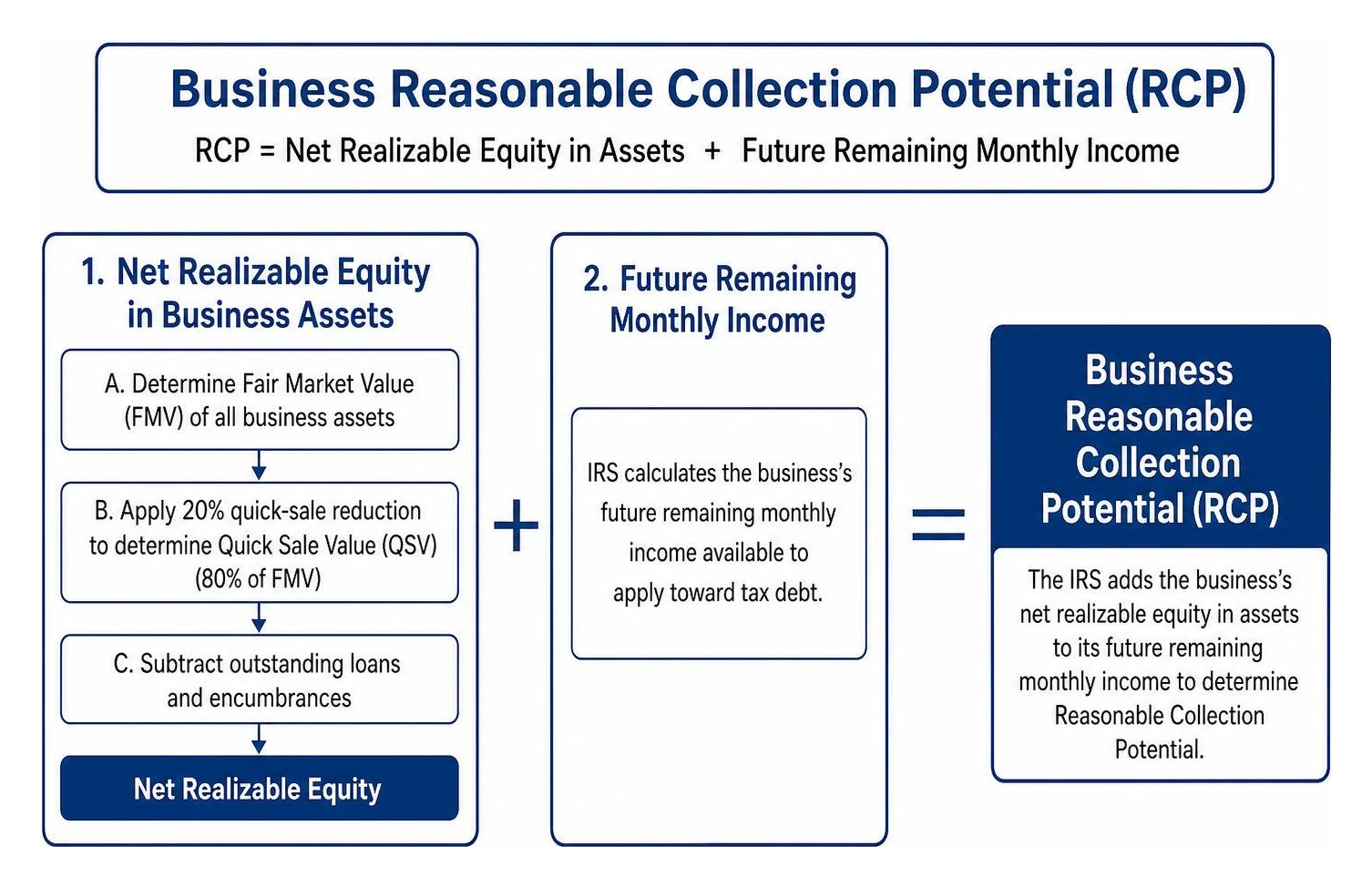
When you submit an offer, the IRS does not negotiate like a standard commercial collection agency. Instead, it applies a rigid formula to determine your company's Reasonable Collection Potential (RCP). As detailed in our guide on how Offer in Compromise Reasonable Collection Potential works, the IRS adds your business's net realizable equity in assets to its future remaining monthly income.

# Net realizable equity in business assets
To determine asset equity, the IRS calculates the Fair Market Value (FMV) of all corporate property and applies a standard 20% quick-sale reduction factor, establishing the Quick Sale Value (QSV) at 80% of market value. Outstanding loan balances and encumbrances are then subtracted:
- Cash and Operating Accounts: Liquid balances across checking, savings, and merchant processor holding accounts are calculated at full value.
- Digital Assets and Cryptocurrency: Form 433-B (OIC) requires explicit disclosure of custodial exchange balances and self-hosted wallet addresses at fair value.
- Accounts Receivable (A/R): Outstanding invoices are aged and discounted based on collectibility factors (typically 70% to 80% for current accounts, with larger discounts for aging debts).
- Machinery, Tools, and Equipment: Valued at 80% QSV minus secured commercial equipment loans.
- Real Property and Vehicles: Corporate real estate and vehicle fleets are evaluated at 80% of verified market value minus valid recorded liens.
# Future remaining monthly income multipliers
Next, the IRS examines average monthly cash flow over the prior 6 to 12 months. The examiner totals average gross monthly revenue and subtracts allowable operating expenses to identify your remaining monthly income.
Non-cash deductions that reduce your tax bill on paper — specifically depreciation and depletion — are explicitly disallowed when calculating allowable monthly operating expenses for an OIC.
| Offer Type | Multiplier Applied | Payment Window | RCP Formula |
|---|---|---|---|
| Lump Sum Cash Offer | 12 Months | Paid within 5 months of written acceptance | Net Realizable Equity + (Remaining Monthly Income × 12) |
| Periodic Payment Offer | 24 Months | Paid over 6 to 24 months from submission date | Net Realizable Equity + (Remaining Monthly Income × 24) |
Lump sum uses a 12-month income multiplier; periodic payment uses a 24-month multiplier that often raises the minimum required offer.
# How to apply: forms, payments, and required documentation
Applying for a business compromise requires assembling comprehensive corporate financial records and submitting the official IRS application booklet. You must use the official IRS Form 433-B (OIC) Collection Information Statement alongside Form 656.
Partnerships and corporations are barred from using the IRS online pre-qualifier tool; they must compile their documentation and submit the official Form 656-B application packet manually. If your business records are disorganized or you have overdue compliance hurdles, completing meticulous Back Tax Preparation is an indispensable first step.
# Documenting financials for an Offer in Compromise for business application
The IRS requires comprehensive substantiation for every line item entered on Form 433-B (OIC). When preparing your package, review the latest Taxpayer Advocate Service guidance on OIC terms to avoid common procedural errors. You must include:
- Complete bank statements for all business accounts covering the previous 6 to 12 months.
- Current year-to-date Profit & Loss (P&L) statements and Balance Sheets.
- Federal income tax returns for the past three filing years.
- Current accounts receivable aging reports and notes receivable schedules.
- Vehicle and commercial equipment titles, registrations, and loan payoff statements.
- A complete disclosure of any business assets sold, gifted, or transferred for less than fair market value over the past 10 years (or real estate transfers within the last 3 years).
# Lump sum cash vs. periodic payment terms
Submitting an OIC requires paying a statutory non-refundable application fee of $205, alongside an initial non-refundable offer payment based on the payment path you choose:
- Lump Sum Cash Option: You must submit an initial down payment of 20% of your total proposed offer amount with Form 656. If approved, the remaining 80% balance must be paid in full in five or fewer installments within five months of acceptance.
- Periodic Payment Option: You must submit your first regular monthly installment payment alongside the application packet and continue paying that monthly installment every month while the IRS evaluates the offer. If approved, the remaining balance is paid out over an agreed timeline between 6 and 24 months.
Critical CPA Takeaway
These down payments and application fees are non-refundable. If the IRS rejects your offer, the agency applies all submitted funds directly against your existing tax balance.
# Federal IRS vs. state business tax compromise rules
Resolving your federal IRS debt addresses only half the equation if your business also carries delinquent state obligations, such as state sales tax, state income tax, or franchise fees. State taxing authorities evaluate compromise requests completely independently from federal determinations; an accepted IRS OIC does not guarantee approval at the state level.
# State agency programs and multi-agency coordination
State compromise programs differ markedly from federal protocols in form requirements, liability definitions, and eligibility thresholds. For instance:
- The California CDTFA Form 490-C business application governs state sales and use tax compromises. Unlike federal rules, CDTFA rules generally require that the business did not collect and withhold sales tax reimbursement from customers on the disputed transactions.
- The California FTB 4905 BE business compromise booklet evaluates corporate income and franchise taxes, often requiring operating businesses to cancel or dissolve their corporate charter with the Secretary of State as a condition of compromise.
- Municipal rules, such as the City of Los Angeles business tax compromise rules, have distinct local compliance requirements and independent payment parameters for city-level gross receipts taxes.
# Differences in payment structures and collateral agreements
State taxing bodies rarely allow periodic payment plans for compromise settlements, typically demanding a single lump-sum payout once preliminary approval is granted. Furthermore, state agencies frequently evaluate collection potential over a concise 4-year collection window, and they often condition final approval on signing a mandatory 5-year collateral agreement. Under a collateral agreement, the entity or its owners pledge to remit a percentage of future business earnings that exceed a set threshold back to the state.
# Risks, acceptance terms, and alternative tax relief options
An Offer in Compromise offers a fresh start, but it is not without risks and binding legal obligations. Submitting an application tolls (extends) the 10-year statutory Collection Statute Expiration Date (CSED) for the duration of the evaluation period plus 30 days.
Before committing to an offer, review options under the broader IRS Fresh Start Program to confirm an OIC is the most advantageous strategic route.

# The 5-year compliance rule and public record disclosures
If the IRS accepts your compromise, your business enters a strict 5-year probationary period. Under these acceptance terms, your business must timely file every federal and state tax return on or before its legal deadline, timely pay all corporate taxes, estimated tax payments, and federal payroll tax deposits, and forfeit any tax refunds due for periods preceding the accepted offer.
If your business defaults on these conditions within the 5-year window, the IRS can immediately rescind the agreement, reinstate the entire original tax balance plus accrued penalties and interest, and initiate aggressive collection action. Additionally, by law, accepted offers are placed on public file in the IRS District Office for one full year, allowing public inspection of your settlement terms.
# Viable alternatives if your business OIC is rejected
If your business has too much asset equity or cash flow to qualify for an OIC, other effective tax resolution strategies remain available:
- IRS Independent Office of Appeals: If an offer is unfairly rejected, you have 30 days from the rejection notice to submit Form 13711 (Request for Appeal of Offer in Compromise) along with a detailed written protest.
- Currently Not Collectible (CNC) Status: If your business is experiencing extreme temporary financial distress, entering Currently Not Collectible status halts all IRS levy and garnishment actions without requiring upfront settlement cash.
- Installment Agreements: Structuring manageable IRS Payment Plans allows your enterprise to pay down tax balances over time while maintaining daily operations.
- Partial Payment Installment Agreements: When an OIC is out of reach, our Partial Pay Installment Agreements (PPIA) Guide explains how to make affordable monthly payments until the statutory collection period expires, legally shedding the remaining unpaid balance.
- Penalty Abatement: Pursuing Penalty Abatement can strip away hefty failure-to-file and failure-to-pay penalties under First-Time Abate administrative rules or reasonable cause criteria.
Frequently Asked Questions (FAQ)
Q: Can an operating business settle unpaid payroll taxes through an Offer in Compromise?
Yes, an operating business can compromise outstanding payroll tax liabilities. However, the IRS enforces stringent compliance rules. The business must be completely current on all federal tax deposits for the current quarter and previous two quarters. Concurrently, business owners and responsible officers must resolve any individual Trust Fund Recovery Penalty assessments to prevent personal asset collection.
Q: How long does the IRS take to evaluate a business Offer in Compromise?
Evaluating a business OIC typically takes between 6 and 18 months due to the detailed verification of business asset equity, accounts receivable, and cash flow. Under federal law, if the IRS does not make an official determination on a processable offer within 24 months (two years) of receipt, the offer is legally deemed automatically accepted.
Q: What happens if our business OIC is rejected by the IRS or state tax authority?
If your offer is rejected, the tax authority will provide a detailed rejection letter explaining their asset and income calculations. You have exactly 30 calendar days from the date of the letter to file an administrative appeal using Form 13711. If an appeal is unviable, you can transition your case into a Partial Payment Installment Agreement, traditional payment plan, or penalty abatement request.
Summary & Next Steps
Resolving business tax debt is a complex legal and financial procedure where a single reporting error or procedural miscalculation can cost your company thousands of dollars. Navigating Reasonable Collection Potential formulas, protecting owners against personal Trust Fund Recovery Penalties, and managing strict ongoing compliance require seasoned representation. At Next Level Tax Resolution, Inc., we leverage more than 20 years of direct IRS negotiation experience to evaluate your books, design comprehensive resolution strategies, and minimize your daily involvement in the process. Reach out to our team today to explore our professional tax debt resolution services and secure a viable path forward for your business. This is general information, not tax advice for your specific situation. Next Level Tax Resolution, Inc. is not affiliated with or endorsed by the IRS. Individual outcomes vary and are not guaranteed.
Katherine M. Johnson, CPA, CTRS
Katherine M. Johnson is a licensed CPA with over 30 years of experience and a Certified Tax Resolution Specialist (CTRS). She personally handles every case — representing individuals and businesses before the IRS and state revenue departments nationwide.
Related Guides & Articles
12 Questions to Ask Any Tax Resolution Firm Before Giving Them a Credit Card
Protect yourself from commissioned call centers. Ask these 12 questions to verify whether a licensed CPA, EA, or attorney will actually work on your file.
Reasonable Cause Penalty Relief: How Serious Illness or Natural Disaster Removes Penalties
Did a severe medical crisis or natural disaster prevent you from filing on time? The IRS waives failure-to-file penalties if you establish reasonable cause.
Currently Not Collectible (CNC) Status: How to Pause IRS Collection Entirely
If paying your tax debt would prevent you from affording food, rent, or utilities, the IRS can place your account in hardship status. Levies stop while the 10-year clock keeps running.