
Missed a Payroll Tax Deposit? What the Trust Fund Recovery Penalty Means for You Personally
Missed a 941 deposit? The Trust Fund Recovery Penalty can make you personally liable for your business's payroll tax debt. What it is and who it reaches.

Katherine M. Johnson, CPA, CTRS
Lead Tax Resolution CPA
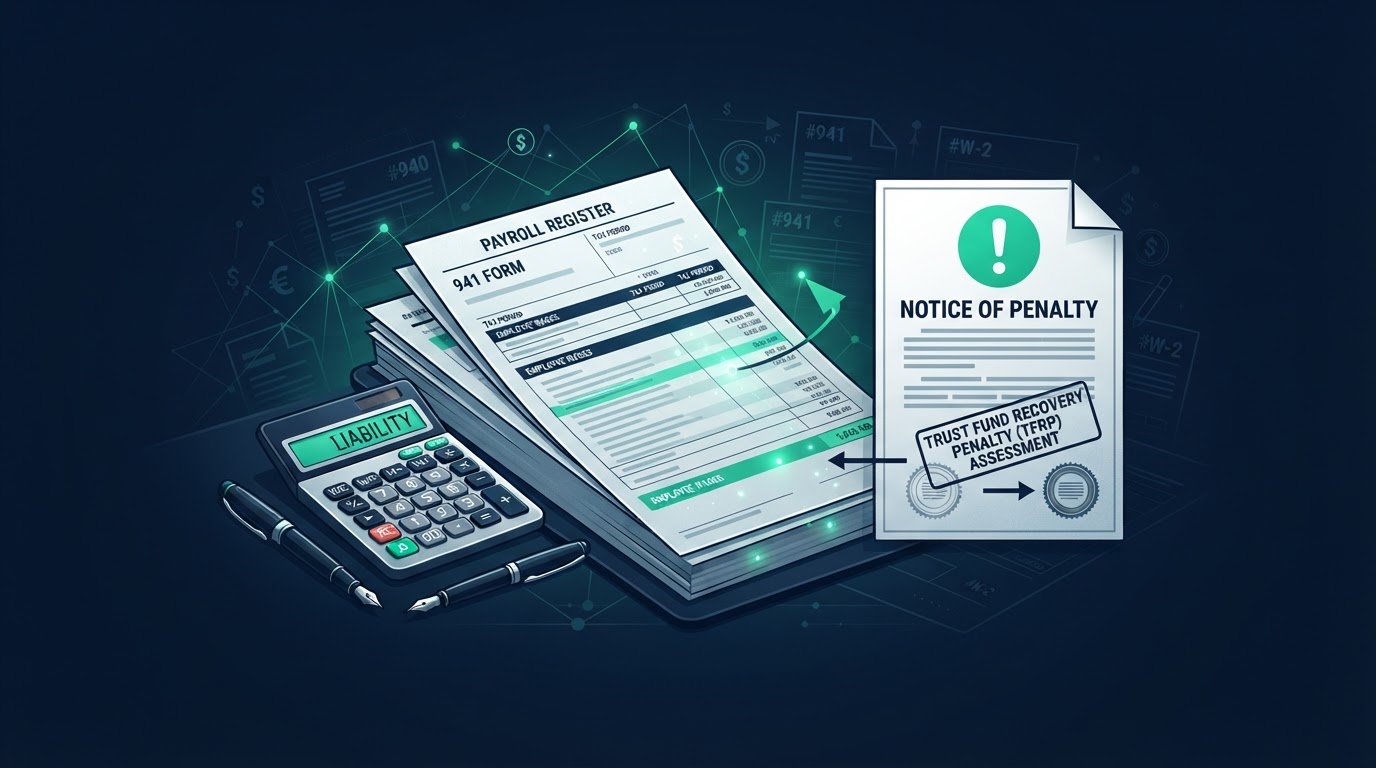
The Trust Fund Recovery Penalty (TFRP) is a personal assessment the IRS can make against an individual — not the business — equal to the unpaid trust fund portion of payroll taxes (federal income tax withholding and the employee share of Social Security and Medicare). It applies when a 'responsible person' 'willfully' failed to pay over withheld payroll taxes. 'Responsible' is broader than 'owner' and can include officers, managers, and even bookkeepers with real financial authority.
If you've fallen behind on payroll tax deposits — the withholding from your employees' paychecks that's supposed to go to the IRS — and you've started reading about the Trust Fund Recovery Penalty, the anxiety you're feeling is a reasonable response to what you're reading, not an overreaction. This is genuinely one of the more serious situations in this field, because it's one of the few places where a business debt can become a personal one. You deserve a straight explanation of how it actually works, not just the version that shows up in search results at 1am.
# Why payroll taxes are treated differently from every other business debt
When you run payroll, a portion of every employee's paycheck — federal income tax withholding and the employee's share of Social Security and Medicare — never belonged to the business. It was withheld from the employee and is being held, in trust, to be paid over to the IRS. That's the "trust fund" the penalty is named for.
Because that money was never the business's to spend, the IRS treats a shortfall differently than it treats, say, an unpaid vendor invoice or a missed loan payment. A business that's behind on rent is a business problem. A business that's behind on the trust fund portion of payroll taxes is a problem the IRS can reach past the business entity to address directly — and it can do that even if the business later closes, is sold, or files for bankruptcy protection on its other debts.
# What the Trust Fund Recovery Penalty actually is
The Trust Fund Recovery Penalty is a personal assessment the IRS can make against an individual — not the business — equal to the unpaid trust fund portion of the payroll taxes. It isn't a separate fine layered on top of what's owed. It's a mechanism for collecting the trust fund taxes directly from a person, when the business itself hasn't paid them.
Two things have to be true for the IRS to assess it against you: you have to be a responsible person, and your failure to pay has to have been willful. Both terms mean something specific, and neither means what most people assume.
Facing This Exact IRS Situation?
Don't speak with an automated call center or non-licensed salesperson. Speak directly with Katherine M. Johnson, CPA, CTRS.
# Who counts as a "responsible person"
This is broader than most business owners expect, and it's worth sitting with. The IRS looks at status, duty, and authority — specifically, whether someone had the power to decide which creditors got paid and the authority to direct that payroll taxes be paid over to the IRS.
- Owners, officers, and partners
- Corporate officers and LLC members, whether or not they're involved in day-to-day operations
- A general manager or controller with real check-signing or financial authority
- In some cases, a bookkeeper or accounts-payable employee — if they genuinely had authority over which bills got paid, not just the task of writing checks someone else approved
Critical CPA Takeaway
What generally doesn't count: someone performing purely ministerial tasks — processing payroll on instruction, without independent judgment or authority over what gets paid. The distinction the IRS draws is between doing the task and deciding the priority. More than one person at the same business can be found responsible for the same period.
# What "willful" actually means
This is the part that surprises people most. Willful, in this context, doesn't mean malicious, and it doesn't require any intent to defraud the government. It means intentional, deliberate, voluntary, reckless, or knowing — as opposed to accidental.
In practice, that generally means: you knew the payroll taxes were due, and you knew (or should have known) they weren't being paid, and you had the authority to pay them but chose to pay something else instead — payroll itself, a critical vendor, rent, a loan payment to keep the doors open. That choice, even one made with entirely good intentions to save the business, is exactly the kind of decision the willfulness standard is built around. It doesn't need to feel like wrongdoing at the time for it to meet the legal standard later.
# What the process actually looks like
This doesn't happen by surprise on a single letter. There's a defined investigation process, and understanding it helps you know where you stand.
- 1. Investigation and interview: The IRS typically conducts an interview — using Form 4180 — with each person it believes may be responsible, to establish the facts around authority and decision-making.
- 2. Internal recommendation: The revenue officer prepares a recommendation for the group manager based on that investigation.
- 3. Letter 1153 — proposed assessment: If the IRS concludes you're a responsible person, you'll receive a formal proposed assessment notice.
- 4. Your response window: You generally have 60 days to respond or appeal before the proposed assessment becomes final.
Critical CPA Takeaway
Never attend a Form 4180 interview without representation. What you say in that interview is the primary evidence the IRS uses to decide whether you're responsible and whether your conduct was willful.
# Common ways this goes wrong for business owners
Assuming the business closing ends the exposure. It doesn't. The trust fund portion of the liability generally survives the business, because it was never the business's debt to begin with — it was always, legally, the employees' withheld money.
Assuming only the owner is at risk. Officers, managers, and sometimes staff with real financial authority can all be evaluated. Everyone with check-signing authority during the relevant periods should understand their own exposure, not just assume it's the owner's problem.
"Pyramiding" the liability. Falling behind one quarter and telling yourself you'll catch up next quarter — while continuing to miss deposits — is the pattern the IRS treats most seriously, because it looks less like a temporary setback and more like an ongoing decision to use withheld taxes as working capital.
Going to the Form 4180 interview alone, assuming it's routine. It generally is not routine, and what's said there is difficult to walk back later.
# Why professional support matters here specifically
This is one of the situations where representation earns its place early rather than after something has already gone wrong. Before an interview happens, before a recommendation is finalized, there's real room to establish the facts accurately — who actually had authority, who didn't, what the business's financial picture looked like at the time, and whether a payment plan for the business itself can address the exposure before it becomes personal to anyone. Katherine reviews the full picture — transcripts, corporate structure, and the actual decision-making authority during the relevant quarters — before any interview takes place. More on how we handle IRS collection defense →
If the business itself can still address the liability directly — through a structured payment arrangement — that's often the strongest way to prevent the exposure from becoming personal in the first place.
Frequently Asked Questions (FAQ)
Q: What is the Trust Fund Recovery Penalty?
A personal assessment the IRS can make against an individual, equal to the unpaid trust fund portion of payroll taxes — the income tax and employee FICA withholding a business failed to pay over. It shifts the debt from the business to a person.
Q: Who can be held personally liable for a business's payroll taxes?
Anyone found to be a "responsible person" — someone with the authority to decide which bills got paid and whether payroll taxes were among them. That can include owners, officers, and in some cases managers or bookkeepers with real financial authority.
Q: Can I be liable if I'm just the bookkeeper?
Potentially, if you genuinely had authority over which creditors were paid — not if you were simply processing payroll on someone else's instruction. This distinction is exactly why the facts of your specific role matter.
Q: What is a Form 4180 interview?
The interview the IRS uses to establish who's responsible and whether the failure to pay was willful. It's a significant step in the process and shouldn't be attended without representation.
Q: Will the IRS shut down my business over this?
It's possible, particularly where the pattern continues quarter after quarter without resolution. It's also not the most common outcome, and addressing the liability early — at the business level, before it's assessed personally — is the strongest way to avoid it.
Q: Does closing the business make this go away?
No. The trust fund portion of the liability generally survives the business closing, because it was never the business's own money.
Q: Can my business get a payment plan for payroll taxes?
Often, yes, including arrangements designed for operating businesses that need to keep meeting current payroll while addressing the back balance.
Summary & Next Steps
The facts of who had authority and what happened get harder to establish clearly the longer this sits. Call (800) 236-3741, or book a time, before an interview is scheduled rather than after. This is general information, not tax advice for your specific situation. Next Level Tax Resolution, Inc. is not affiliated with or endorsed by the IRS. Penalties and interest continue to accrue on unpaid balances until resolved.
Katherine M. Johnson, CPA, CTRS
Katherine M. Johnson is a licensed CPA with over 30 years of experience and a Certified Tax Resolution Specialist (CTRS). She personally handles every case — representing individuals and businesses before the IRS and state revenue departments nationwide.
Related Guides & Articles
When an IRS Revenue Officer Visits Your Business: What You Should and Shouldn't Do
Revenue Officers are field enforcement agents assigned to high-dollar or payroll tax cases. Learn your rights when an officer makes contact.
How to Stop Wage Garnishment and Regain Your Paycheck
Receiving an IRS wage garnishment can leave you with very little to cover living expenses. Learn how IRS wage levies work, exemption rules, and how a CPA can release the garnishment.
Tax Lien Release vs. Withdrawal vs. Subordination vs. Discharge: Which Do You Need?
Refinancing a home or selling property with a federal tax lien? Learn which of the four lien remedies applies to your situation so you don't lose weeks at closing.