
How to Stop Wage Garnishment and Regain Your Paycheck
Receiving an IRS wage garnishment can leave you with very little to cover living expenses. Learn how IRS wage levies work, exemption rules, and how a CPA can release the garnishment.

Katherine M. Johnson, CPA, CTRS
Lead Tax Resolution CPA
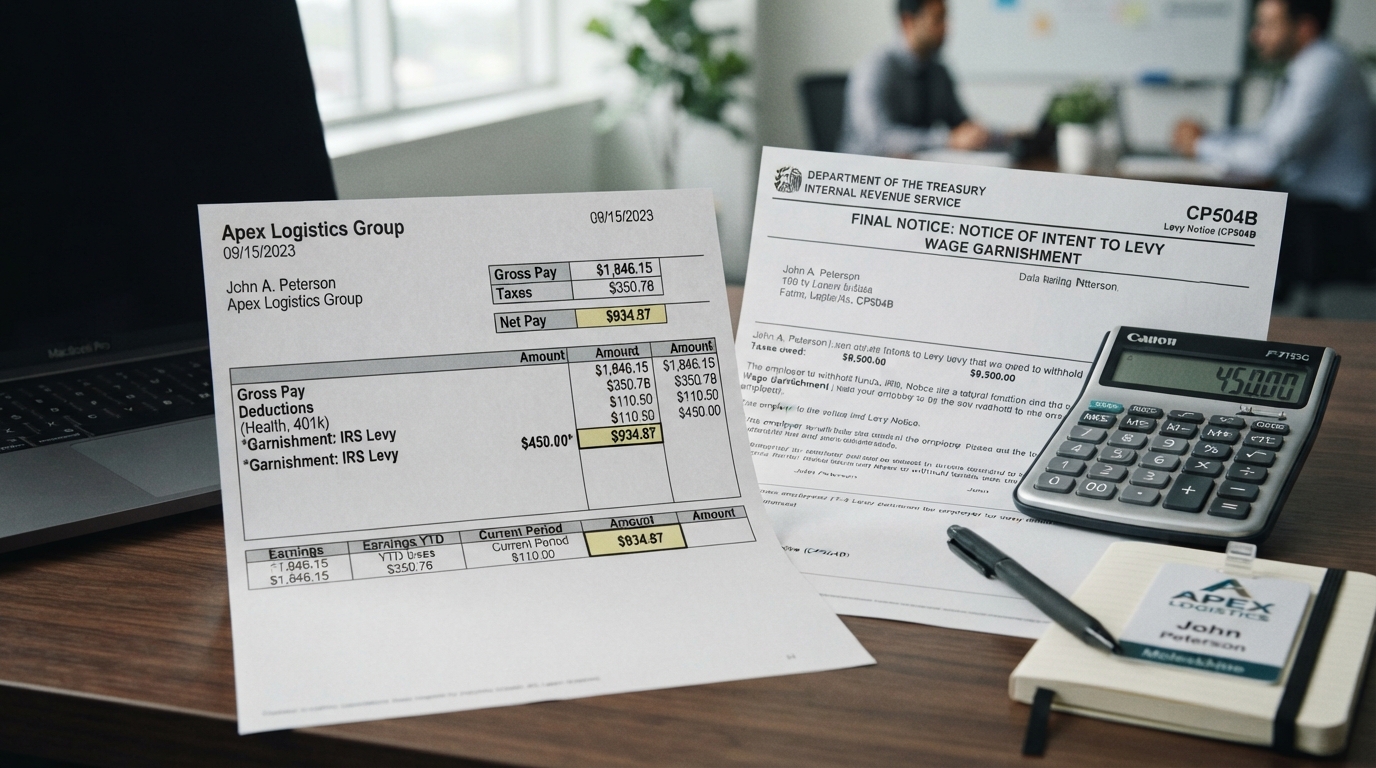
An IRS wage garnishment ([Form 668-W](/irs-notices/form-668-w)) can be stopped by demonstrating economic hardship under IRC § 6343(a)(1)(D), establishing an approved Direct Debit Installment Agreement, securing Currently Not Collectible (CNC) status, or filing missing returns. Submitting IRS Form 2848 Power of Attorney allows a CPA to negotiate an immediate levy release (Form 668-D) on your behalf.
Receiving notice of an IRS wage garnishment or discovering a sudden reduction in your paycheck can be incredibly distressing. An IRS wage levy is a continuous enforcement action served on your employer, leaving you with only a small statutory exempt allowance. Understanding how tax garnishments work and knowing how an authorized CPA can intervene helps you take immediate steps to halt the garnishment and protect your income.
# How an IRS Wage Garnishment Works & The Exemption Table Rules
An IRS wage garnishment is fundamentally different from commercial debt garnishments. While commercial creditors are legally capped at taking 25% of your disposable earnings, the IRS works in reverse: they leave you a fixed exempt amount based on Publication 1494 tables and take 100% of everything else.
When your employer receives Form 668-W (Notice of Levy on Wages), they are legally required to comply. You are given Part 3 (Statement of Exemptions and Filing Status) to complete. If you do not return Part 3 within 3 days, your employer must default your exemption to Married Filing Separately with zero dependents—the lowest exemption amount available.
Critical CPA Takeaway
An IRS wage levy is continuous. It attaches to every single pay period indefinitely until the IRS issues an official Form 668-D Release of Levy.
# Why the IRS Garnishes Wages and How to Prepare
The IRS generally issues a wage levy after sending a series of written notices culminating in Notice LT11 or Letter 1058 (Final Notice of Intent to Levy and Notice of Your Right to a Hearing). Ignoring these notices triggers automated collection enforcement.
To prepare for a levy release, take immediate action: locate your latest notice, verify your filing compliance for prior tax years, gather current income and living expense records, and consult a licensed CPA before attempting to contact the IRS directly.
- Locate Notice LT11, Letter 1058, or Form 668-W to confirm exact tax years and dates.
- Complete and submit Part 3 of Form 668-W to your employer immediately to protect your base exemption.
- Gather bank statements, pay stubs, housing, and utility records to prove monthly expenses.
- Verify whether you have unfiled back tax returns that must be prepared to achieve filing compliance.
- File IRS Form 2848 (Power of Attorney) to authorize a CPA to negotiate directly with IRS collection officers.
Facing This Exact IRS Situation?
Don't speak with an automated call center or non-licensed salesperson. Speak directly with Katherine M. Johnson, CPA, CTRS.
# Proven Strategies to Stop an IRS Wage Garnishment
Stopping a wage garnishment requires replacing the levy with an acceptable resolution method or proving that the levy prevents you from meeting basic necessities. Key strategies include:
1. Proving Economic Hardship (IRC § 6343): Under IRS guidelines, the IRS must release a levy if it creates immediate financial hardship preventing you from paying basic housing, food, utilities, or medical care.
2. Direct Debit Installment Agreement (DDIA): Entering into an approved payment plan replaces the involuntary paycheck garnishment with an agreed-upon monthly payment.
3. Currently Not Collectible (CNC) Hardship Status: If your allowable expenses equal or exceed your gross income, your account can be placed in Status 53, suspending all collection levies.
4. Offer in Compromise (OIC): Submitting an eligible settlement application under Reasonable Collection Potential (RCP) guidelines can suspend active levy enforcement.
- Economic Hardship Release: Form 433-A/F financial disclosure proving basic living costs exceed income.
- Direct Debit Installment Agreement: Automated monthly draft replacing continuous payroll levy.
- Currently Not Collectible (CNC) Status: Hardship pause for taxpayers on fixed or low income.
- Filing Compliance Prerequisite: All delinquent tax returns must be filed to unlock any resolution option.
# What Does CPA Tax Representation Involve During a Levy Emergency?
Professional representation allows a licensed CPA or Certified Tax Resolution Specialist (CTRS) to handle all communications with IRS collection agents on your behalf. After completing Form 2848 Power of Attorney, your representative can:
Review your IRS account transcripts electronically via e-Services to identify exact tax years and balance breakdowns.
Contact the assigned Revenue Officer or Automated Collection System (ACS) agent to request an immediate temporary stay of enforcement.
Prepare and submit missing back returns and financial disclosure statements (Form 433-A/F).
Secure an official Form 668-D (Release of Levy/Garnishment) transmitted directly to your payroll department.
# Common Mistakes to Avoid & How Long a Release Takes
Avoid common pitfalls during a wage levy emergency: do not ignore Form 668-W Part 3, do not quit your job or request cash under the table, do not submit incomplete or contradictory financial forms, and do not delay seeking professional representation.
How long a release takes depends on your filing status and responsiveness. If you are already filing-compliant and can document economic hardship, a CPA can often secure a levy release within 24 to 72 hours by faxing Form 668-D directly to your employer's payroll department.
- Do Not Ignore Employer Forms: Returning Part 3 of Form 668-W protects your baseline exempt paycheck amount.
- Act Quickly: Every pay period that passes results in money permanently remitted to the Treasury.
- Establish Filing Compliance: Preparing delinquent returns is the gate through which all levy releases pass.
Frequently Asked Questions (FAQ)
Q: Can I get back wages that the IRS has already garnished from my paycheck?
Wages that have already been remitted by your employer to the IRS are generally non-refundable unless you can prove the levy was issued in error or violated statutory Notice LT11 Collection Due Process rules.
Q: Can my employer fire me for having an IRS wage garnishment?
Federal law (15 U.S.C. 1674) prohibits employers from discharging an employee because their earnings have been subjected to garnishment for any single indebtedness.
Summary & Next Steps
An IRS wage garnishment is an urgent financial emergency, but it can be stopped with prompt, experienced representation. At Next Level Tax Resolution, Katherine Johnson, CPA, CTRS establishes immediate contact with the IRS, documents economic hardship, and secures Form 668-D wage levy releases. Contact us today at (800) 236-3741 to protect your paycheck and regain financial control.
Katherine M. Johnson, CPA, CTRS
Katherine M. Johnson is a licensed CPA with over 30 years of experience and a Certified Tax Resolution Specialist (CTRS). She personally handles every case — representing individuals and businesses before the IRS and state revenue departments nationwide.
Related Guides & Articles
When an IRS Revenue Officer Visits Your Business: What You Should and Shouldn't Do
Revenue Officers are field enforcement agents assigned to high-dollar or payroll tax cases. Learn your rights when an officer makes contact.
Tax Lien Release vs. Withdrawal vs. Subordination vs. Discharge: Which Do You Need?
Refinancing a home or selling property with a federal tax lien? Learn which of the four lien remedies applies to your situation so you don't lose weeks at closing.
How Much Can the IRS Take From Your Paycheck? (Wage Garnishment Exemption Rules)
Unlike regular creditors who take 25%, the IRS uses exemption tables to leave you with a small fixed allowance and takes 100% of the rest. Learn how completing Form 668-W protects your check.