
The Easiest Way to Understand Installment Agreement Options
Short-term, guaranteed, streamlined, partial-pay, and in-business trust fund plans — how each IRS installment agreement works, who qualifies, and what it costs to set up.

Katherine M. Johnson, CPA, CTRS
Lead Tax Resolution CPA
An IRS installment agreement is an authorized payment plan (under IRC § 6159) that lets a taxpayer pay unpaid tax debt over time instead of in a lump sum. The main types are short-term plans (up to 180 days, under $100,000), guaranteed agreements ($10,000 or less, 36 months), streamlined agreements (up to $50,000, up to 72 months, no financial disclosure), routine/non-streamlined plans (over $50,000, full Form 433-F/A disclosure), partial-pay agreements (PPIA, for hardship, paid until the 10-year collection statute expires), and in-business trust fund express agreements (up to $25,000 over 24 months for active businesses). Interest and the failure-to-pay penalty continue while a plan is active, though the penalty drops from 0.5% to 0.25% per month once an agreement is approved for an on-time filer.
Installment agreements are payment plans that let you pay unpaid federal or state taxes over time instead of all at once. For IRS debt, the arrangement is authorized under Internal Revenue Code Section 6159 and can help you avoid more aggressive collection action when you cannot pay in full today. The right plan depends on how much you owe, your income and expenses, and how quickly you can realistically pay the balance — so understanding the categories before you apply is what keeps the process from becoming a setback.
# What installment agreements are and what they are not
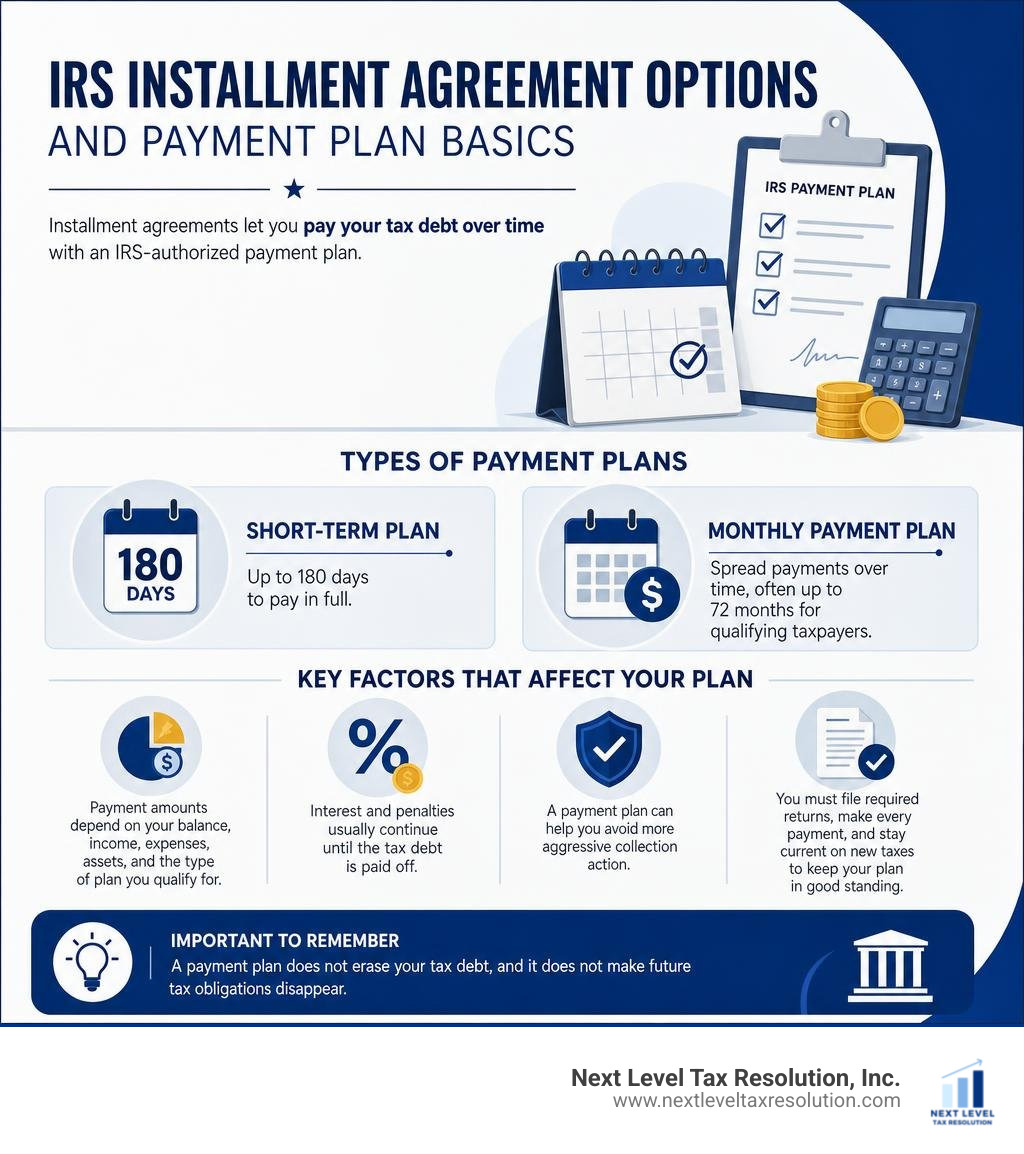
Installment agreements are payment plans that let you pay unpaid federal or state taxes over time instead of all at once. For IRS debt, the arrangement is authorized under Internal Revenue Code Section 6159 and can help you avoid more aggressive collection action when you cannot pay in full today.
A payment plan does not erase the debt, and it does not make future tax obligations disappear. You still need to file required returns, make every scheduled payment, and stay current on new taxes to keep the agreement from defaulting. It is a structured way to satisfy a balance you genuinely owe — not a settlement or a reduction.

- Short-term plans give you up to 180 days to pay in full.
- Monthly IRS plans spread payments out over a longer period, often up to 72 months for qualifying taxpayers.
- Payment amounts depend on your balance, income, expenses, assets, and the type of plan you qualify for.
- Interest and penalties usually continue until the tax debt is paid off, even while a plan is active.
Critical CPA Takeaway
A payment plan protects you from levies and garnishments while it is active — but only while you stay compliant. Miss a payment, skip a future return, or take on new tax debt and the agreement can default, reopening collection action.
# Types of federal installment agreements and eligibility rules
Federal tax resolution is not a one-size-fits-all process. The Internal Revenue Code provides distinct administrative relief programs depending on your total assessed liability, current cash flow, and asset equity. When negotiating with the IRS, the primary objective is to align your financial standing with a structured monthly arrangement before the statutory 10-year Collection Statute Expiration Date (CSED) elapses.
Reviewing the official Instructions for Form 9465 reveals that federal guidelines differentiate between streamlined processes and full-disclosure plans. We often help clients structure practical IRS payment plans to avoid unnecessary financial disclosures and protect essential personal assets.
The table below highlights the primary IRS installment agreement categories available as of August 2026:
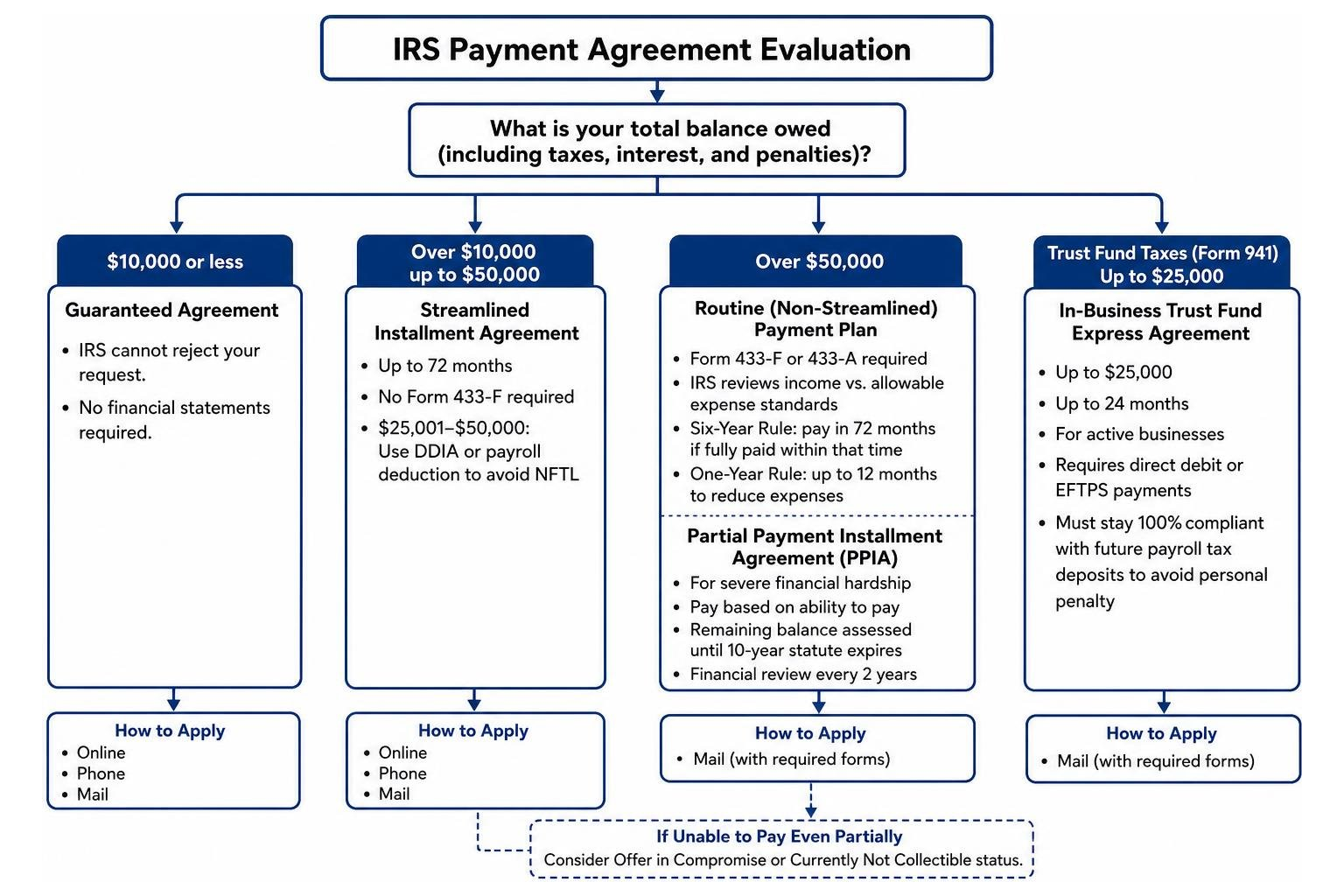
- Short-Term Plan — under $100,000, up to 180 days, no financial disclosure, direct debit optional.
- Guaranteed — $10,000 or less, up to 36 months, no financial disclosure, direct debit optional.
- Streamlined (Tier 1) — up to $25,000, up to 72 months, no financial disclosure, direct debit optional.
- Streamlined (Tier 2) — $25,001 to $50,000, up to 72 months, no financial disclosure, direct debit mandatory.
- Routine / Non-Streamlined — over $50,000, up to CSED (10 years), Form 433-F/433-A required, direct debit mandatory.
- Partial Pay (PPIA) — flexible balance, up to CSED, full financial verification, direct debit mandatory.
- In-Business Trust Fund Express — up to $25,000, up to 24 months, no financial disclosure, direct debit/EFTPS mandatory.
Facing This Exact IRS Situation?
Don't speak with an automated call center or non-licensed salesperson. Speak directly with Katherine M. Johnson, CPA, CTRS.
# Guaranteed and short-term payment plans
If you owe a relatively small tax liability or simply need a brief cushion to free up capital, the IRS provides two straightforward options.
Short-term payment plans: for individuals who owe less than $100,000 in combined tax, penalties, and interest, the IRS allows an extension of up to 180 days to satisfy the debt in full. The IRS charges a $0 setup fee for establishing a short-term plan.
Guaranteed installment agreements: under Internal Revenue Code § 6159(c), the IRS is statutorily mandated to accept your proposed payment plan if you meet specific thresholds. Because guaranteed agreements are mandated by federal statute, the IRS cannot reject your request or demand detailed financial statements showing your living costs.
- Your tax debt (excluding penalties and interest) is $10,000 or less.
- You have filed all tax returns and paid all taxes due for the prior five tax years.
- You have not entered into an installment agreement during any of those prior five years.
- You agree to fully pay the balance within 36 months (3 years).
- You demonstrate that you cannot pay the liability immediately in full.
# Streamlined installment agreements for balances under $50,000
If your assessed balance exceeds $10,000 but remains at $50,000 or less in combined taxes, interest, and late-payment penalties, you can secure a streamlined installment agreement. Stemming from the historical IRS Fresh Start initiative, streamlined terms allow individual taxpayers to pay off their balance over a maximum term of 72 months without submitting exhaustive financial collection forms.
To fully understand these administrative relief guidelines, explore our breakdown on understanding the IRS Fresh Start Program and how it works.
- No Financial Disclosure Statement (Form 433-F): you do not have to verify your monthly grocery budgets, equity in vehicles, or home valuations.
- Notice of Federal Tax Lien (NFTL) avoidance: for balances between $25,001 and $50,000, establishing an automated Direct Debit Installment Agreement (DDIA) or payroll deduction agreement prevents the IRS from filing a public Notice of Federal Tax Lien against your property.
# Partial payment and routine payment plans
What happens if you owe substantially more than $50,000, or your disposable monthly income cannot support a 72-month payoff? The IRS offers comprehensive collection alternatives.
Routine (non-streamlined) payment plans: when your tax liabilities exceed $50,000, the IRS requires detailed financial disclosures using Form 433-F or Form 433-A (Collection Information Statement). The IRS evaluates your income against National and Local Allowable Expense Standards. Under the IRS Six-Year Rule, you may pay the balance over 72 months without strict expense limits if the debt will be fully satisfied within that timeframe. Alternatively, the One-Year Rule grants you up to 12 months to downsize or eliminate excessive discretionary expenses to meet monthly payment requirements.
Partial Payment Installment Agreements (PPIA): authorized under the American Jobs Creation Act, a PPIA allows qualifying taxpayers experiencing severe financial hardship to make affordable monthly payments based strictly on their verified ability to pay, rather than the total amount owed. The remaining balance remains unpaid until the 10-year collection statute expires, at which point the uncollected debt is extinguished. PPIAs are subject to a mandatory biennial (every two years) financial review by the IRS.
For an in-depth look at qualification requirements and equity analysis, read our comprehensive Partial Pay Installment Agreements (PPIA) guide.
If a taxpayer cannot afford even partial payments, alternative relief paths such as submitting an Offer in Compromise to settle the debt for less, or securing temporary hardship relief through Currently Not Collectible status, should be considered.
Critical CPA Takeaway
A PPIA does not pay the debt in full — it pays what you can afford until the collection statute runs out. That makes the biennial financial review the most important date on the calendar: if your income improves, the IRS can raise the payment or convert the plan.
# In-business trust fund express agreements
Operating small businesses facing delinquent employment taxes (Form 941) can enter into an In-Business Trust Fund Express Agreement. This plan allows active businesses to resolve trust fund balances up to $25,000 over a period of up to 24 months.
Because unpaid payroll taxes involve trust fund taxes withheld from employee paychecks, the IRS monitors these plans stringently. Eligible businesses must enroll in automated direct debit or EFTPS payments and remain 100% compliant with all future payroll tax deposits to avoid personal Trust Fund Recovery Penalty assessments against company officers.
# Application methods, setup fees, and low-income relief
Setting up an installment agreement requires choosing the right application method to minimize administrative user fees and secure quick approval. Taxpayers can apply through three channels.
Online Payment Agreement (OPA) application: individual taxpayers owing $50,000 or less can apply directly through the IRS online payment agreement tool. Applying online provides immediate confirmation and access to the lowest setup fees.
Submitting Form 9465 by mail: you can prepare and mail Form 9465 (Installment Agreement Request) to the designated IRS Service Center. If your balance exceeds $50,000 or you are seeking a partial pay plan, you must attach a completed Form 433-F (Collection Information Statement) alongside supporting documents.
Phone application: individuals can call 800-829-1040, while operating businesses can contact the IRS business line at 800-829-4933 to negotiate terms directly with an agent.
Before submitting an application through any channel, all past-due tax returns must be filed. The IRS will immediately reject any payment plan request if you have outstanding, unfiled returns on your master file account. If you have delinquent returns, start with unfiled back tax return preparation before requesting a plan.

- Online application with direct debit (DDIA): $22 setup fee.
- Phone, mail, or in-person with direct debit: $107 setup fee.
- Online application with non-direct debit (check/card): $69 setup fee.
- Phone, mail, or in-person with non-direct debit: $178 setup fee.
- Payroll deduction agreement (Form 2159): $178 setup fee.
Critical CPA Takeaway
Taxpayers with an AGI at or below 250% of the federal poverty level qualify for fee relief: a DDIA is $0, a non-direct-debit plan is $43 (reimbursed on completion), and Form 13844 can be filed within 30 days if the discount is not automatically applied.
# Managing compliance, interest, penalties, and default risks
Entering into an installment agreement protects you from aggressive enforcement actions like bank levies or wage garnishments. However, the plan requires ongoing compliance to avoid default and escalating costs.
An approved installment agreement does not freeze statutory interest or penalties. By law, the IRS continues to assess interest compounded daily on any unpaid tax balance. However, entering into an approved installment agreement provides a clear financial benefit regarding late-payment penalties: the standard failure-to-pay penalty (IRC § 6651) normally accrues at 0.5% per month (up to a maximum of 25% of the unpaid tax), but once an installment agreement is approved for an individual who filed their return on time, the penalty drops to 0.25% per month for every month the agreement remains active.
The IRS will automatically seize future federal and state tax refunds and apply them directly toward the outstanding balance. A tax refund offset does not substitute for your regularly scheduled monthly payment; you must continue making your scheduled monthly payment even in the month a refund is applied.
If penalties represent a significant portion of your balance, you may qualify for administrative relief under First-Time Penalty Abatement or Reasonable Cause criteria. Discover how to reduce these charges through penalty abatement alongside our comprehensive suite of tax debt resolution services.
# Modifying terms and preventing agreement defaults
If your financial circumstances change, you can modify an existing agreement online through the OPA portal for a modest $10 user fee (compared to $89 via phone or mail). Modifying your plan allows you to adjust your monthly payment amount, change your monthly payment due date (between the 1st and 28th), update your banking routing and account details, or convert a check-paying plan to direct debit.
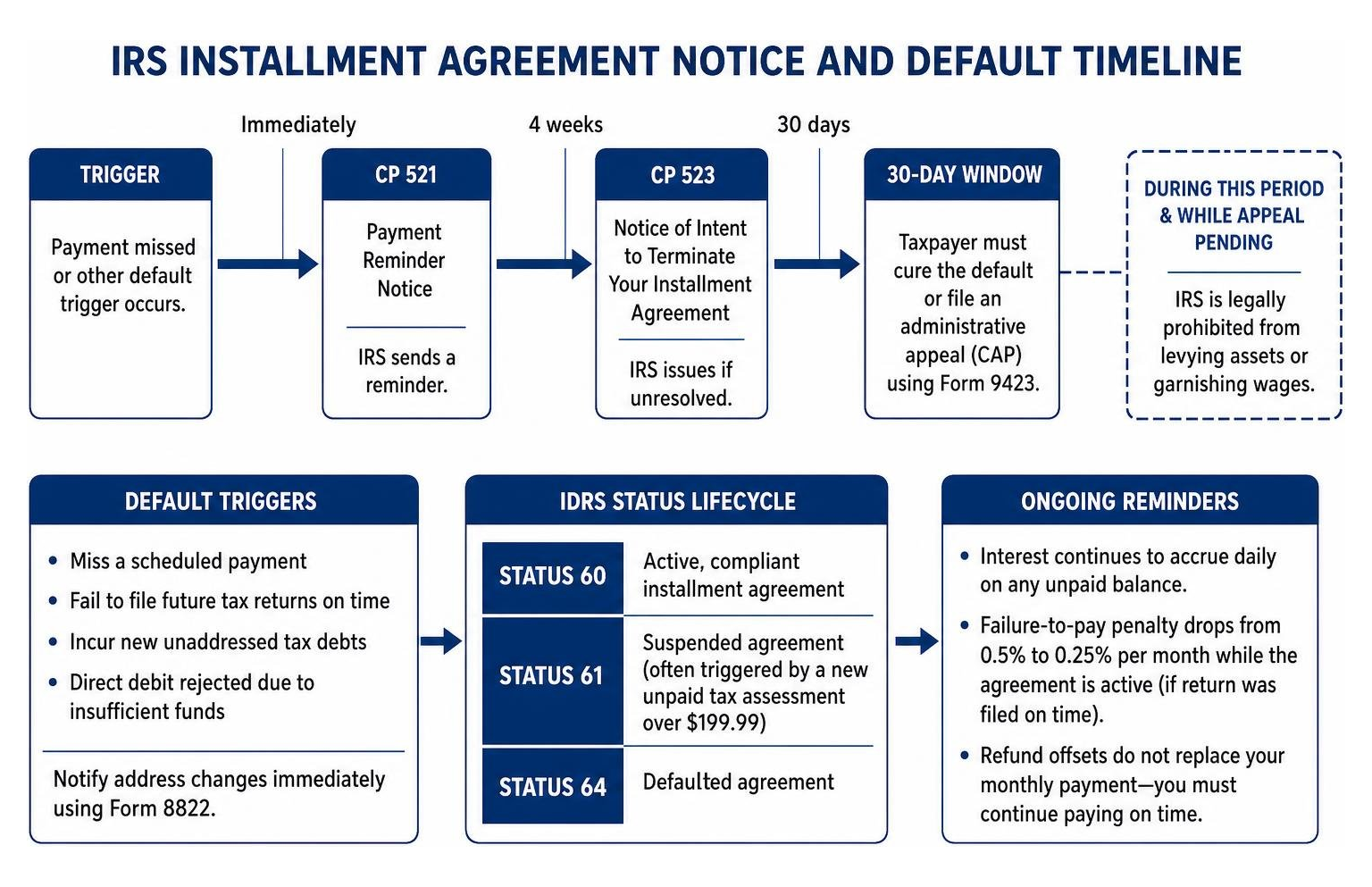
The IRS monitors payment agreements through internal Integrated Data Retrieval System (IDRS) status codes: Status 60 is an active, compliant installment agreement; Status 61 is a suspended agreement (often triggered by a new unpaid tax assessment over $199.99); and Status 64 is a defaulted agreement.
An agreement enters default if you miss a scheduled payment, fail to file future tax returns on time, incur new unaddressed tax debts, or have a direct debit rejected due to insufficient funds. When a payment is missed, the IRS sends a CP 521 payment reminder notice. If unresolved after four weeks, the IRS issues a CP 523 notice of intent to terminate your installment agreement. Taxpayers have a 30-day window from the date of the CP 523 notice to cure the default or file an administrative appeal under the Collection Appeals Program (CAP) using Form 9423. During this 30-day period and while an appeal is actively pending, the IRS is legally prohibited from levying assets or garnishing wages.
To ensure you never miss critical warning notices, always notify the IRS immediately of any address changes using Form 8822. If you have already received a termination notice, read what to do when you receive an IRS LT11 or final notice of intent to levy.
Critical CPA Takeaway
The 30-day window after a CP 523 is the last clean off-ramp before the agreement terminates and collection action resumes. Filing a CAP appeal (Form 9423) within that window pauses levies and garnishments while the appeal is pending.
# Comparing state tax plans with federal standards
Resolving state tax liabilities requires navigating independent state collection codes. State revenue agencies often enforce stricter timelines, higher down payments, and lower debt limits than the IRS.
Repayment horizons: while the IRS routinely permits 72-month terms under streamlined rules, state tax agencies frequently cap repayment plans for businesses at 12 to 24 months, with individual plans often limited to 36 to 60 months. Down payment requirements: unlike the IRS, which does not require an upfront down payment to activate a payment plan, several state agencies mandate an immediate 10% down payment alongside mandatory ACH electronic debit authorization. Tax lien determinations: state agencies often maintain much lower statutory thresholds for filing public tax liens — some jurisdictions automatically file state tax liens on any payment plan extending beyond 12 months or exceeding $25,000 in total debt. Application setup fees: state setup fees are frequently tacked directly onto the outstanding tax balance rather than billed separately.
For a broader comparison, see how state tax revenue departments move faster than the IRS and why that catches people off guard.
Frequently Asked Questions (FAQ)
Q: How does an installment agreement affect the 10-year collection statute?
Under IRC § 6502, the IRS generally has 10 years from the formal tax assessment date to collect outstanding balances (the Collection Statute Expiration Date, or CSED). When you submit an installment agreement request, the running of the 10-year clock is suspended (tolled) while the application is formally pending, during any administrative appeals, and for an additional 30 days following a rejection or notice of default.
Q: What happens if the IRS rejects or terminates my payment plan?
If the IRS rejects your application or issues a CP 523 notice of default, you are entitled to appeal under the Collection Appeals Program (CAP). You have 30 days from the notice date to submit IRS Form 9423 (Collection Appeal Request). While the appeal is pending, the IRS cannot levy your bank accounts, seize property, or garnish your wages.
Q: Can I qualify for an agreement if I have unfiled tax returns?
No. The IRS requires complete tax filing compliance before approving any payment plan. If you have delinquent, unfiled federal tax returns for prior tax years, your installment agreement request will be automatically rejected. You must prepare and submit all delinquent returns before the IRS will formalize a monthly repayment schedule.
Q: Does an installment agreement stop interest and penalties?
No. Interest continues to accrue daily on the unpaid balance while a plan is active. However, once an installment agreement is approved for a taxpayer who filed their return on time, the failure-to-pay penalty drops from 0.5% to 0.25% per month for as long as the agreement remains in good standing.
Summary & Next Steps
Managing unpaid tax balances can feel overwhelming, but an installment agreement offers a clear, manageable path toward financial stability. Whether you qualify for a guaranteed 36-month plan, a streamlined 72-month direct debit agreement, or a Partial Payment Installment Agreement, structuring the right resolution protects your bank accounts, wages, and personal assets from aggressive collection enforcement. Ready to resolve your tax liabilities with confidence? Explore our tailored IRS payment plans to take control of your financial future today. This is general information, not tax advice for your specific situation. Next Level Tax Resolution, Inc. is not affiliated with or endorsed by the IRS. Individual outcomes vary and are not guaranteed.
Katherine M. Johnson, CPA, CTRS
Katherine M. Johnson is a licensed CPA with over 30 years of experience and a Certified Tax Resolution Specialist (CTRS). She personally handles every case — representing individuals and businesses before the IRS and state revenue departments nationwide.
Related Guides & Articles
Can You Buy a House or Qualify for a Mortgage When You Owe Back Taxes?
Underwriters ask for tax transcripts and proof of filing. Learn how setting up a documented installment agreement clears the path to mortgage approval.
Smart Tax Planning Strategies to Minimize Stress and Maximize Savings
Effective tax planning is a proactive process that helps individuals and business owners make informed financial decisions throughout the year instead of scrambling when filing deadlines approach.
Substitute for Return (SFR): Why the IRS's Number Is Almost Always Too High
When you don't file, the IRS files an SFR on your behalf using 1099s/W-2s — with ZERO deductions or exemptions. Learn how preparing an original return reduces or eliminates that balance.