
Penalty Abatement: Reduce or Remove IRS Tax Penalties Legally
IRS penalties can quickly double or triple your tax bill. Learn how First-Time Abatement and Reasonable Cause relief allow taxpayers to legally reduce or eliminate IRS tax penalties.

Katherine M. Johnson, CPA, CTRS
Lead Tax Resolution CPA
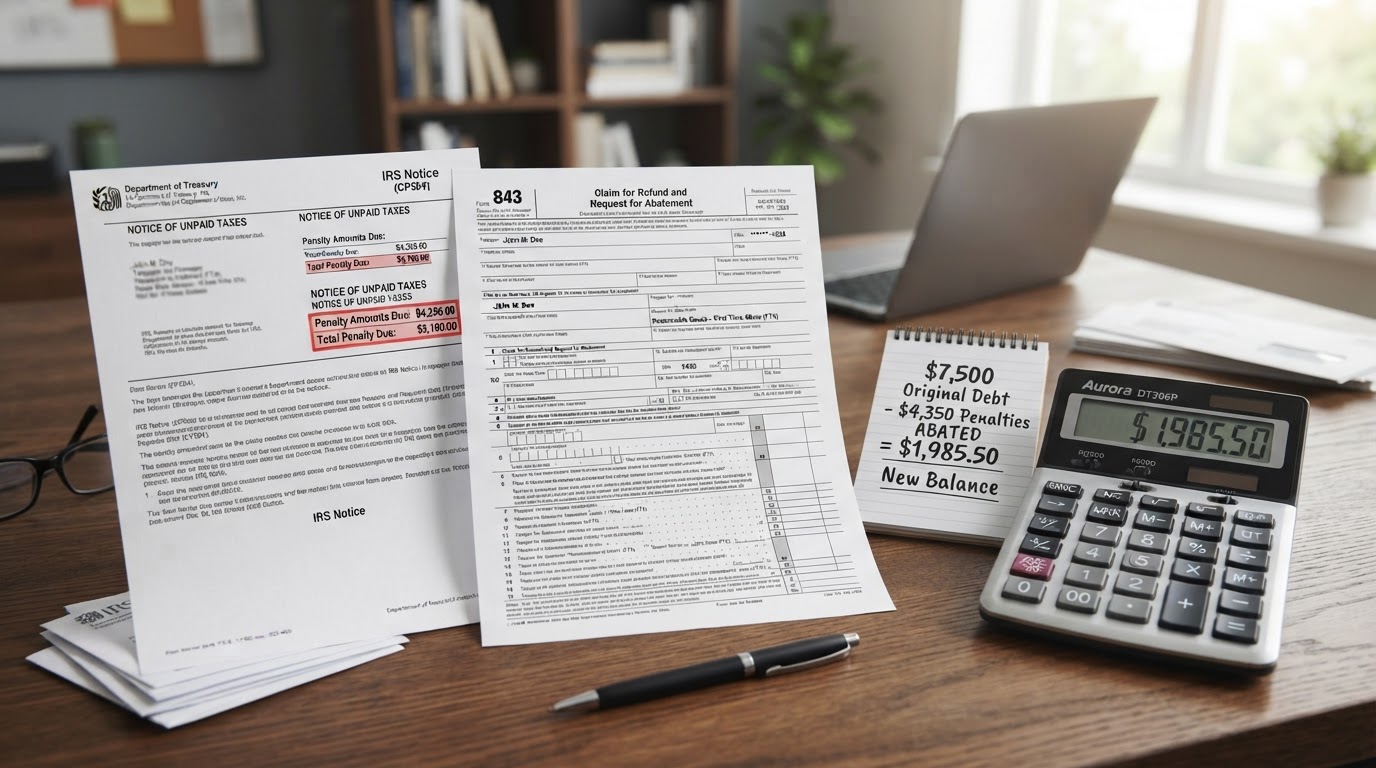
IRS penalty abatement is the legal reduction or cancellation of failure-to-file, failure-to-pay, or accuracy-related penalties under Internal Revenue Code § 6651 and IRM 20.1. Taxpayers can qualify through First-Time Penalty Abatement (FTA) for clean prior compliance, or Reasonable Cause Relief by proving uncontrollable life events like severe illness, disaster, or lost records.
Getting hit with IRS penalties can feel like the situation is spiraling fast. What starts as a missed deadline or underpayment can quickly grow into a much larger financial burden once failure-to-file and failure-to-pay penalties and interest are added. The good news is that penalty abatement offers a legitimate, legal way to reduce or even eliminate certain IRS penalties if you qualify and follow the proper administrative or statutory process.
# What IRS Penalties Include & How They Stack
Before looking at how penalties can be removed, it helps to understand what you are dealing with. The IRS applies penalties for a variety of reasons, and they can stack on top of each other over time, compounding exponentially with daily accrued interest.
Common penalties include: 1) Failure to File (5% per month up to 25% max), 2) Failure to Pay (0.5% per month up to 25% max), 3) Underpayment of Estimated Taxes (Form 2210), and 4) Accuracy-Related Penalties (20% for negligence or substantial understatement under IRC § 6662).
These penalties are not small add-ons. In many cases, penalties and compounding interest make up 30% to 50% of the total balance due. According to official IRS policy, taxpayers facing financial hardship or qualifying noncompliance circumstances have clear administrative remedies to request full or partial penalty removal.
Critical CPA Takeaway
Did you know? When the IRS abates a penalty, all compounding interest that accrued on that specific penalty is automatically erased as well!
# What Is Penalty Abatement? (First-Time Abatement vs. Reasonable Cause)
Penalty abatement is a formal administrative request to the IRS asking for statutory penalties to be reduced or completely removed. It does not erase the original principal tax owed, but it can significantly lower your total balance due by eliminating added charges.
There are two primary ways taxpayers qualify for legal penalty relief:
1. First-Time Penalty Abatement (FTA): Available under IRM 20.1.1.3.3.2.1 for taxpayers with a clean compliance history. If you have filed and paid on time for the 3 tax years prior to the penalty year, the IRS grants automatic administrative relief for a single tax year.
2. Reasonable Cause Relief: Applies under IRC § 6651 when a legitimate, uncontrollable hardship prevented you from meeting filing or payment deadlines despite exercising ordinary business care and prudence.
- Serious illness or medical emergencies affecting you or an immediate family member.
- Natural disasters, fires, floods, or unforeseen catastrophic events.
- Death in the immediate family or primary caregiver.
- Inability to obtain records due to destruction, theft, or third-party failure beyond your control.
Facing This Exact IRS Situation?
Don't speak with an automated call center or non-licensed salesperson. Speak directly with Katherine M. Johnson, CPA, CTRS.
# Why Many Taxpayers Fail to Claim Relief They Qualify For
One of the biggest misconceptions about IRS penalties is that they are fixed and non-negotiable. In reality, thousands of taxpayers qualify for penalty abatement each year but never pursue it.
Common reasons taxpayers miss out on penalty relief include confusing or intimidating IRS notices, assuming penalties are mandatory, lacking knowledge of Internal Revenue Manual (IRM) guidelines, and feeling overwhelmed by strict documentation requirements.
In many cases, taxpayers end up paying thousands of dollars in penalties they didn't legally owe simply because they didn't know relief was an available option.
# How the IRS Evaluates Your Abatement Request & Step-by-Step Process
The IRS evaluates each abatement request using automated criteria (Reasonable Cause Assistant or RCA) and individual Revenue Officer review. Decisions hinge on whether your explanation and documentation support your claim under ordinary business care standards.
To submit a successful request, follow these structured steps:
1. Review your IRS account transcript to identify exact penalty transaction codes (e.g., Code 276 or Code 166).
2. Determine whether you meet First-Time Abatement or Reasonable Cause criteria.
3. Gather objective supporting documentation (medical statements, police reports, death certificates, insurance claims).
4. Prepare IRS Form 843 (Claim for Refund and Request for Abatement) or a written reasonable cause statement citing specific IRM sections.
5. Submit the claim to the appropriate IRS Service Center and follow up if processing is delayed.
- Verify compliance: All required back tax returns must be filed before the IRS will consider penalty relief.
- Establish payment arrangement: You must be in an approved Installment Agreement, Currently Not Collectible status, or paid in full.
- Avoid vague statements: Provide precise dates linking the hardship event directly to the missed tax deadline.
# Professional Guidance: Working with a CPA to Maximize Savings
While taxpayers can submit Form 843 independently, navigating complex tax years or multi-year penalty assessments often requires licensed representation. Certified Tax Resolution Specialists (CTRS) understand how to present facts in compliance with Internal Revenue Manual standards.
At Next Level Tax Resolution, Katherine Johnson, CPA, CTRS evaluates your complete IRS account transcript, identifies every qualifying penalty year, files Form 843 or Form 2848 Power of Attorney, and appeals improper denials with the IRS Office of Appeals.
Combining penalty abatement with structured installment agreements or an Offer in Compromise ensures you achieve the maximum possible reduction on your total tax liability.
Frequently Asked Questions (FAQ)
Q: Does penalty abatement remove interest accrued on the tax balance?
While interest on the underlying tax cannot be abated under First-Time Abatement, any interest accrued on the abated penalty itself is automatically removed once the penalty is cancelled.
Q: Can I request penalty abatement if I have already paid the tax bill in full?
Yes! If you paid the penalty within the past 3 years (or 2 years from when the tax was paid, whichever is later), you can file Form 843 to claim a full refund of abated penalties.
Summary & Next Steps
IRS penalties can add unnecessary stress to an already difficult situation, but they are not set in stone. With the right documentation, IRM knowledge, and professional CPA representation, you can legally reduce or remove penalties. Contact Next Level Tax Resolution today at (800) 236-3741 or book a consultation to evaluate your penalty relief options.
Katherine M. Johnson, CPA, CTRS
Katherine M. Johnson is a licensed CPA with over 30 years of experience and a Certified Tax Resolution Specialist (CTRS). She personally handles every case — representing individuals and businesses before the IRS and state revenue departments nationwide.
Related Guides & Articles
12 Questions to Ask Any Tax Resolution Firm Before Giving Them a Credit Card
Protect yourself from commissioned call centers. Ask these 12 questions to verify whether a licensed CPA, EA, or attorney will actually work on your file.
Reasonable Cause Penalty Relief: How Serious Illness or Natural Disaster Removes Penalties
Did a severe medical crisis or natural disaster prevent you from filing on time? The IRS waives failure-to-file penalties if you establish reasonable cause.
Currently Not Collectible (CNC) Status: How to Pause IRS Collection Entirely
If paying your tax debt would prevent you from affording food, rent, or utilities, the IRS can place your account in hardship status. Levies stop while the 10-year clock keeps running.