
How Kentucky Handles Unpaid Taxes Differently Than the IRS (and Why It Catches People Off Guard)
Kentucky's Department of Revenue moves faster than the IRS and has powers the IRS doesn't — including license actions. What Kentucky taxpayers should know.

Katherine M. Johnson, CPA, CTRS
Lead Tax Resolution CPA
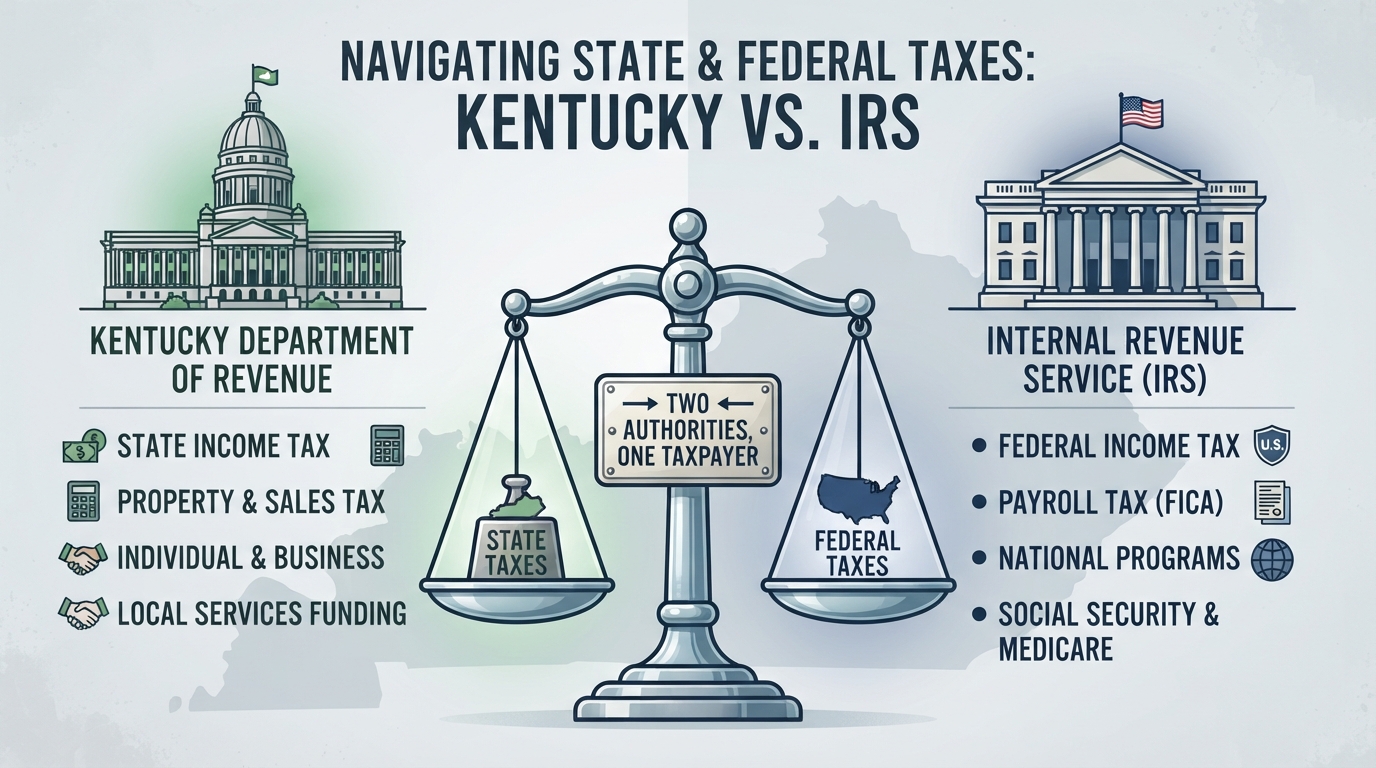
Kentucky and the IRS are entirely separate tax authorities. Resolving a federal balance does not resolve, pause, or affect a Kentucky balance. Kentucky's collection timeline is shorter than the federal one — its first notice starts a roughly 60-day protest window before referral to collections, which adds a one-time cost-of-collection fee of around 25%. Kentucky also has enforcement tools the IRS does not use domestically, including the ability to act against certain professional and business licenses.
A good share of the calls I take from Kentucky taxpayers start the same way: someone was already dealing with the IRS, felt like they had a handle on it, and then a letter from the Kentucky Department of Revenue arrived and moved faster than anything the IRS had sent. That surprise is common, and it's worth understanding in advance rather than in the middle of it — because Kentucky and the IRS are separate agencies, running separate processes, on separate clocks, and neither one waits for the other.
# Two authorities, two clocks — and resolving one doesn't touch the other
This is the fact that catches most people off guard: an accepted Offer in Compromise with the IRS has no effect whatsoever on a Kentucky balance, and a federal payment plan does nothing to pause Kentucky collection activity. They're not coordinated, and they don't share the same programs, the same forms, or the same criteria.
If you owe both, you genuinely have two situations to resolve — ideally together, for reasons I'll get to, but never as if solving one solves the other.
# How Kentucky's notice sequence compares to the federal one
The IRS's process starts with a CP14 balance-due notice and moves through several reminder notices over a period of months before reaching a Final Notice of Intent to Levy with its 30-day legal deadline.
Kentucky's version is faster. The Department of Revenue's first notice — a Notice of Tax Due — starts a protest period of roughly 60 days from the date of the notice. If that window passes without a formal protest, the balance is referred to the Division of Collections, and two things happen at once: a cost-of-collection fee, generally around 25% of the balance, gets added in a single step, and interest continues accruing on top of it.
That's a materially different shape than the federal sequence, where added costs tend to build up gradually through smaller monthly penalties rather than arrive as one collection-referral fee.
Critical CPA Takeaway
The window to protest an incorrect Kentucky assessment, or to get ahead of the collection referral, is genuinely shorter than most people assume based on their experience with the IRS. Treating a Kentucky notice with the same 'I'll deal with it eventually' instinct that might be survivable with an early federal notice can be a costly assumption.
Facing This Exact IRS Situation?
Don't speak with an automated call center or non-licensed salesperson. Speak directly with Katherine M. Johnson, CPA, CTRS.
# What Kentucky can do that the IRS generally can't reach for domestically
Once a Kentucky balance is in collections, the state has a toolkit that overlaps with the IRS's in some ways and goes well beyond it in others.
- Liens — Like the IRS, Kentucky can file a tax lien with the county clerk; under state law it remains in effect for ten years and attaches to property you own and later acquire.
- Wage and bank levies — Kentucky can garnish wages and levy bank accounts, generally with the same protections for Social Security and disability income that apply federally.
- Refund and payment offsets — Kentucky can intercept both state and federal income tax refunds, and can offset state and federal payments owed to a business. A federal refund can be redirected to satisfy a state debt.
- Business injunctions — In cases involving an ongoing business, Kentucky can pursue legal action including an injunction against the business itself.
- License actions — Under KRS 131.1817, the Department of Revenue can move to revoke a professional license or motor vehicle registration when a tax debt goes unpaid. Under KRS 243.500(5), the Office of Alcoholic Beverage Control can deny or decline to renew a liquor license, and a tax clearance is required before one can be sold or transferred. KRS 131.181 allows revocation of mining-related licenses for tax debt connected to mining, transportation, or processing activity.
Critical CPA Takeaway
The IRS has nothing quite like this domestically. A Kentucky professional license action is a different kind of leverage entirely, and it's the single biggest reason a state balance can become urgent for someone whose livelihood depends on a license: contractors, real estate professionals, healthcare and legal professionals, and a range of licensed trades.
# Why this matters most for small businesses
If you're a small business owner already managing federal payroll tax exposure, Kentucky adds a second front, and one that can move faster. State withholding tax and unemployment tax obligations run on their own filing and payment schedule, separate from the federal deposits, and a shortfall on the state side triggers Kentucky's notice sequence independent of anything happening federally.
For a business already stretched thin, it's entirely possible to be current — or at least engaged — with the IRS while a Kentucky balance quietly moves through its faster collection timeline in the background.
# What to do if you owe both
Get the complete picture first. On an initial call, we establish what's outstanding federally and with Kentucky, and whether either is on a deadline the other isn't.
Pull records from both sides. Kentucky account information alongside IRS transcripts. It's often the first time someone sees the full, combined picture in one place.
Build one strategy that accounts for both. What you can realistically pay Kentucky affects what the IRS will accept, and the reverse is also true. A payment plan or settlement built without accounting for the other authority's claim on your finances can end up undercutting itself.
Negotiate with each authority separately, but in a coordinated way. They're different agencies with different processes, but the numbers have to hold together across both.
- Map every balance — federal and state — before agreeing to anything.
- Coordinate payment amounts so one resolution doesn't starve the other.
- Address any license exposure early if your livelihood depends on it.
Frequently Asked Questions (FAQ)
Q: Does my IRS resolution cover my Kentucky tax debt?
No. They're entirely separate authorities. A federal Offer in Compromise, payment plan, or Currently Not Collectible status has no effect on what Kentucky is owed.
Q: Is Kentucky's process really faster than the IRS's?
Generally, yes. Kentucky's Notice of Tax Due carries roughly a 60-day protest window before referral to collections, compared to the IRS's longer, multi-notice sequence before a final levy warning.
Q: Can Kentucky really affect my professional license over unpaid taxes?
Under Kentucky law, the Department of Revenue can move to revoke certain licenses — including professional licenses and vehicle registrations — for unpaid tax debt, and separate provisions apply to liquor licenses and mining-related licenses. If your livelihood depends on a license and you have a Kentucky balance, this is worth raising early rather than after a notice arrives.
Q: Can Kentucky take my federal tax refund, or vice versa?
Kentucky can offset both state and federal refunds to satisfy a Kentucky balance. This surprises people who assume the two systems don't talk to each other.
Q: Do I need separate representation for Kentucky and the IRS?
Not necessarily — the two are often best handled together by one person who can see the complete picture and build a strategy that works for both, rather than two disconnected resolutions that can undercut each other.
Q: What if I moved to Kentucky, or moved away, during the years I owe?
Kentucky may pursue liability for income earned while you were a resident, and residency questions can get genuinely complicated with a move mid-year or remote work across state lines. That's worth raising specifically rather than assuming based on where you live today.
Summary & Next Steps
Building two resolutions separately, without accounting for each other, is how one ends up undoing the other. Call (800) 236-3741 or (502) 658-6328, or book a time, and we'll look at the complete picture — state and federal — together. Learn more about Kentucky tax problems, state tax resolution, and how Kentucky collection differs from the IRS. This is general information, not tax advice for your specific situation. Next Level Tax Resolution, Inc. is not affiliated with or endorsed by the IRS or the Kentucky Department of Revenue. Interest and applicable fees continue to accrue on unpaid balances until resolved.
Katherine M. Johnson, CPA, CTRS
Katherine M. Johnson is a licensed CPA with over 30 years of experience and a Certified Tax Resolution Specialist (CTRS). She personally handles every case — representing individuals and businesses before the IRS and state revenue departments nationwide.
Related Guides & Articles
State Tax Revenue Departments Move Faster Than the IRS: Here's Why
Resolving your IRS debt does NOT touch your state tax debt. State revenue departments run tighter deadlines, harsher garnishment limits, and can revoke professional licenses.
Penalty Abatement: Reduce or Remove IRS Tax Penalties Legally
IRS penalties can quickly double or triple your tax bill. Learn how First-Time Abatement and Reasonable Cause relief allow taxpayers to legally reduce or eliminate IRS tax penalties.
Payroll Tax Debt & Trust Fund Recovery Penalty: Protecting Small Business Owners
Unpaid 941 payroll taxes are considered stolen trust funds by the IRS. Learn how the Trust Fund Recovery Penalty (TFRP) can reach owners personally.