
How Nonprofits Can Write a Winning 990 Penalty Abatement Letter
Form 990 daily late penalties, reasonable cause under IRM 20.1.1, FTA vs AEP, and the five components of a persuasive 990 penalty abatement letter — with supporting documentation and submission protocol.

Katherine M. Johnson, CPA, CTRS
Lead Tax Resolution CPA
A 990 penalty abatement letter is a written request asking the IRS to remove Form 990 daily late-filing penalties assessed under IRC § 6652(c)(1). To win relief, a nonprofit must show reasonable cause — that it exercised ordinary business care and prudence but was unable to file on time due to circumstances beyond its control (such as key-person incapacitation, record destruction, or unavoidable delays) — and that the failure was not willful neglect. The letter must identify the organization and notice, state the penalty, give a chronological narrative, demonstrate ordinary business care, describe preventive controls, and be signed under penalties of perjury by an authorized officer, with supporting exhibits attached.
When a tax-exempt organization misses the annual Form 990 deadline, the IRS assesses automatic daily delinquency penalties under IRC § 6652(c)(1) — and because those penalties are tied to gross receipts rather than tax owed, even a charity operating at a loss can face tens of thousands of dollars in fines for late paperwork. The good news is that the IRS will abate these penalties when a nonprofit can document reasonable cause and ordinary business care, and a well-structured 990 penalty abatement letter is the vehicle for making that case.
# Understanding Form 990 late filing penalties and IRS rules
When your tax-exempt organization misses the annual Form 990 deadline, the IRS assesses automatic daily delinquency penalties under IRC § 6652(c)(1). Unlike individual income tax penalties, which are calculated as a percentage of unpaid tax liability, Form 990 penalties accrue on a fixed per-day basis based entirely on your organization's gross receipts for the tax year.
The IRS establishes two primary tiers for assessment. For organizations with gross receipts under $1 million, the penalty is $20 per day, capped at the lesser of $10,000 or 5% of gross receipts. For organizations with gross receipts of $1 million or more, the daily rate jumps to $100 per day, up to a maximum of $50,000 per return.
Because these penalties are tied to gross revenue rather than net income or tax owed, even a charity operating at a net financial loss can face substantial fines simply for submitting paperwork late. The statutory formula under § 6652(c)(1) leaves no room for guesswork — the assessment is mechanical once the return is late.
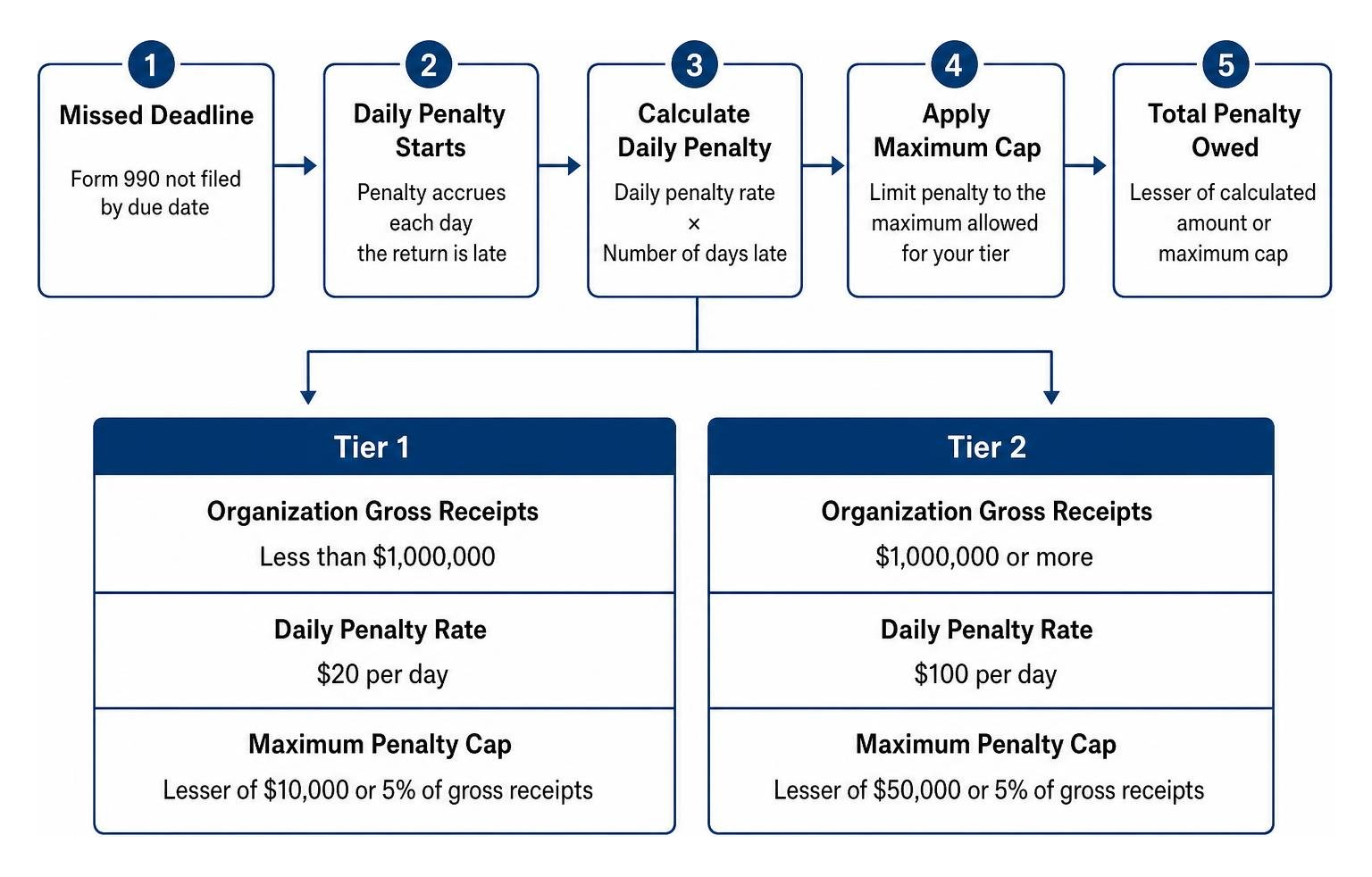
- Under $1,000,000 gross receipts: $20 per day, capped at the lesser of $10,000 or 5% of gross receipts.
- $1,000,000 or more gross receipts: $100 per day, capped at $50,000 per return.
- Penalties accrue automatically once the filing deadline passes — no IRS discretion in the initial calculation.
Critical CPA Takeaway
The long-term risk is bigger than the fine: an organization that fails to file required Form 990-series returns for three consecutive tax years automatically loses its tax-exempt status. At that point donor contributions are no longer deductible and the entity becomes subject to corporate income tax.
# Qualifying grounds for Form 990 penalty relief
To successfully reverse assessed late fees, nonprofits must request administrative or statutory relief under established Internal Revenue Manual (IRM) guidelines. The IRS details these mechanisms in its formal administrative penalty relief guidance.
The standard pathway for waiving 990 late penalties is establishing reasonable cause under IRM § 20.1.1.3.2. To qualify, your nonprofit must prove that it exercised ordinary business care and prudence in attempting to meet its filing obligations but was nevertheless unable to file on time due to circumstances beyond its control — and crucially, that there was no willful neglect.
It is vital to understand court precedents regarding third-party reliance. Under the landmark decision United States v. Boyle, the U.S. Supreme Court established that taxpayers have a non-delegable duty to file returns on time. Relying on an employee, volunteer, or external CPA to file Form 990 does not automatically relieve the board of directors of its legal duty. If your organization faced unexpected hardship, exploring reasonable cause penalty relief options provides the legal foundation for your request.
- Key person incapacitation: the sudden death, severe illness, or unavoidable absence of the individual responsible for tax filings or accounting records.
- Disaster and record destruction: physical destruction of financial records or premises due to fire, flood, natural disaster, or major cyber-attack.
- Unavoidable delays: inability to obtain necessary financial data despite timely, documented efforts from financial institutions or service providers.
Critical CPA Takeaway
Under United States v. Boyle, relying on a volunteer treasurer or paid CPA does not by itself constitute reasonable cause. The board has a non-delegable duty to oversee filing — but relief may still be granted if a severe emergency impacted that person and the board acted promptly upon discovering the omission.
Facing This Exact IRS Situation?
Don't speak with an automated call center or non-licensed salesperson. Speak directly with Katherine M. Johnson, CPA, CTRS.
# First Time Abate (FTA) vs. the 2026 Automatic Exemption from Penalty (AEP)
The IRS offers administrative waiver options alongside reasonable cause. Taxpayers with an exemplary record can utilize the First Time Abate (FTA) waiver. To qualify for FTA, an organization must demonstrate a clean compliance history for the three preceding tax years — no un-abated penalties and no outstanding unfiled returns. Reviewing established first-time penalty abatement guidelines helps confirm whether your nonprofit satisfies these lookback requirements.
Starting in 2026, the IRS is expanding administrative relief with the Automatic Exemption from Penalty (AEP) program. While FTA requires taxpayers to request relief after penalties are assessed, AEP is an automated system designed to prevent penalty assessment upfront for returns filed late in the current tax year, provided the entity maintained timely filing and payment history over the prior three tax years (or 12 consecutive quarters).
Critical CPA Takeaway
FTA is a request-after-the-fact waiver; AEP is automated prevention. Neither replaces a documented reasonable-cause narrative when the organization does not meet the clean-history lookback — and neither excuses willful neglect.
# Step-by-step: how to write a 990 penalty abatement letter
Drafting a 990 penalty abatement letter requires an objective, professional approach centered around factual details and formal declarations. A well-structured request presents your nonprofit's situation logically to the IRS reviewer reading your file. Every persuasive letter should explicitly address five core components.
First, identification: state the organization's full legal name, Employer Identification Number (EIN), tax period year-end date, Form number (Form 990, 990-EZ, or 990-PF), and the specific IRS notice number (such as Notice CP215). Second, the reason for assessment: state the exact penalty type and dollar amount assessed.
Third, a factual narrative: provide a strict chronological timeline of events leading up to the missed deadline, detailing the specific circumstances that prevented compliance. Fourth, ordinary business care and lack of willful neglect: explain how the organization took prudent steps to handle its affairs. Fifth, a preventive action plan: detail the concrete internal controls implemented to ensure future Form 990 returns are filed on time.
Finally, the letter must include a formal declaration under penalties of perjury — that the signer has examined the statement and, to the best of their knowledge and belief, it is true, correct, and complete — signed and dated by an authorized officer such as the Board President, Executive Director, or Treasurer.

- Identification: legal name, EIN, tax period, Form type, and IRS notice number (e.g., CP215).
- Reason for assessment: exact penalty type and dollar amount.
- Factual narrative: chronological timeline of the events that prevented timely filing.
- Ordinary business care: prudent steps taken, demonstrating no willful neglect.
- Preventive action plan: concrete internal controls to prevent a recurrence.
- Perjury declaration: signed and dated by an authorized officer.
Critical CPA Takeaway
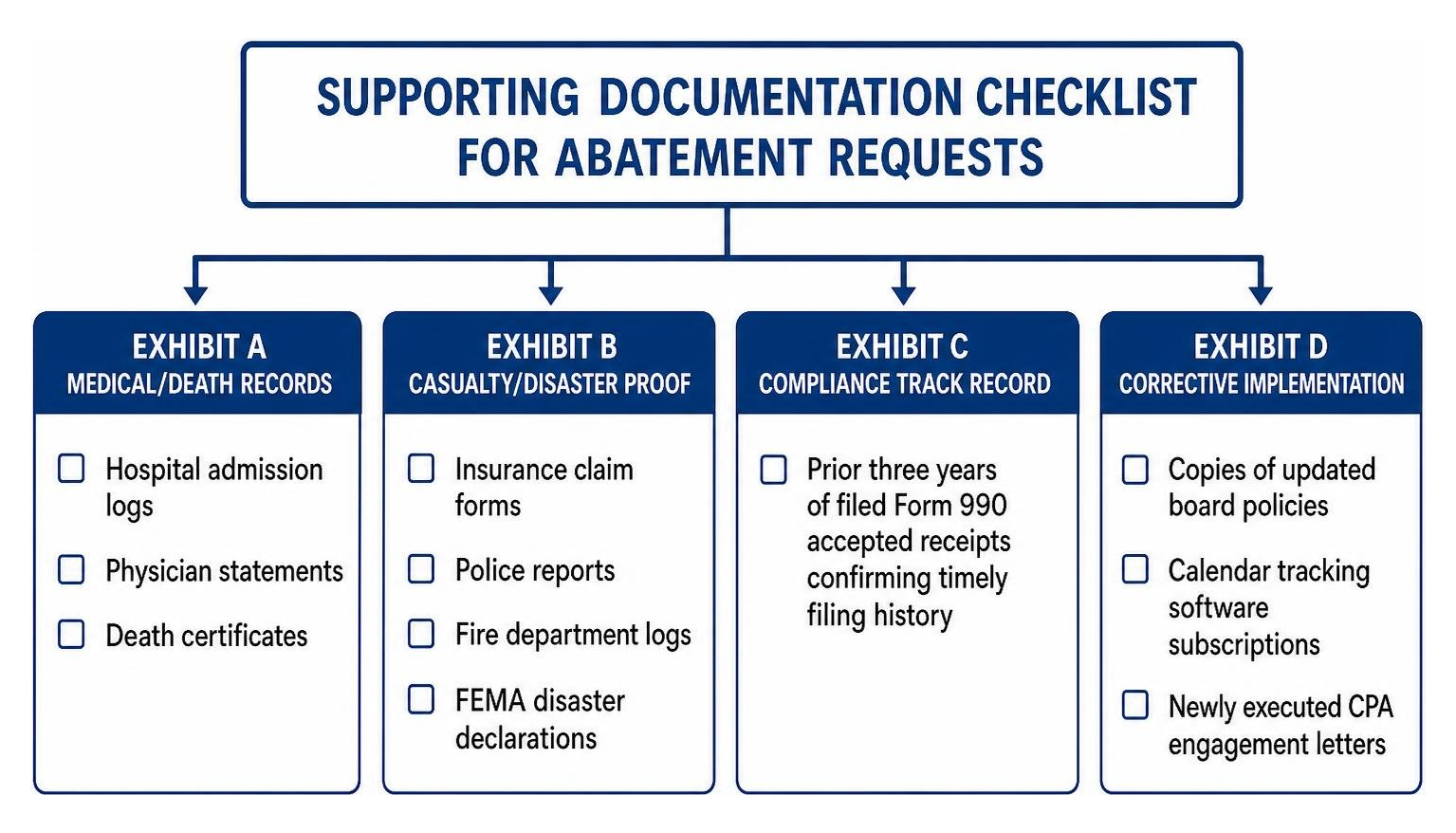
Assertions carry little weight without exhibits. Organize supporting documents as labeled exhibits (Exhibit A, B, C, D) and reference them directly in the letter text — medical or death records, casualty or disaster proof, prior filed 990 receipts, and documentation of corrective controls.
# Submitting your request and managing the IRS response
Once your abatement packet is assembled, proper delivery and follow-up protect your legal rights during administrative processing. Send the completed letter directly to the IRS Service Center address listed on your penalty notice, such as Notice CP215, via Certified Mail with Return Receipt Requested or an approved private delivery service with tracking. This physical proof establishes legal proof of timely submission.
If your nonprofit engages professional tax representation, your representative will submit IRS Form 2848 (Power of Attorney), which allows them to request an administrative hold on your IRS account — pausing automated collection notices and levy escalation while the IRS evaluates your request.
The IRS typically takes 60 to 120 calendar days to process written penalty abatement requests. Under § 6652(c)(1), the penalty formula is strictly fixed by statute, so the IRS has no administrative discretion to offer partial compromises — the request is either accepted in full or denied entirely. If the IRS issues a formal rejection, your organization has the right to file an appeal with the IRS Office of Appeals within 30 days. Deploying proven IRS penalty reduction strategies during the appeals stage provides a critical second chance for total relief.


Critical CPA Takeaway
The IRS cannot split the difference on a Form 990 penalty — it is all or nothing. That is why the documentation quality in the original letter matters more than negotiation: the decision turns on whether reasonable cause is proven, not on bargaining.
Frequently Asked Questions (FAQ)
Q: Can the IRS assess a partial late filing penalty on Form 990?
No. Under IRC § 6652(c)(1), Form 990 daily late filing penalties are calculated using a mandatory statutory formula ($20 or $100 per day up to fixed caps). The IRS does not possess discretionary authority to negotiate or assess a partial penalty fee; the assessment must either stand completely or be fully abated based on administrative rules or reasonable cause criteria.
Q: What happens if our nonprofit relied on volunteer staff who made a mistake?
Under the Supreme Court ruling in United States v. Boyle, reliance on an agent — whether an uncompensated volunteer board treasurer or an external paid CPA — does not by itself constitute reasonable cause for missing a statutory deadline. Nonprofit boards have a non-delegable fiduciary duty to oversee filing obligations. However, relief may still be granted if you can prove that a severe personal emergency directly impacted that volunteer and the board took prompt action upon discovering the omission, backed by professional back tax preparation support.
Q: How long does the IRS take to process a Form 990 penalty abatement request?
IRS Service Centers generally require between 60 and 120 days to review written abatement petitions. Due to seasonal inventory fluctuations, processing times can extend further. Ensure your representative places an administrative hold on the organization's account so collection activity remains frozen while processing takes place.
Q: Does First-Time Penalty Abatement (FTA) apply to Form 990 late penalties?
FTA can apply to Form 990 late-filing penalties if the organization meets the clean compliance lookback — no un-abated penalties and no outstanding unfiled returns for the three preceding tax years. Unlike estimated tax penalties under § 6654, Form 990 penalties under § 6652(c)(1) are not statutory interest charges, so they are eligible for the FTA administrative waiver in addition to reasonable cause.
Summary & Next Steps
Paying heavy late-filing penalties directly depletes funds donated for charitable work, and the larger risk — automatic revocation after three consecutive missed years — can end a nonprofit's exempt status entirely. A winning 990 penalty abatement letter comes down to documented reasonable cause, a clear chronological narrative, and concrete preventive controls. At Next Level Tax Resolution, Inc., we bring more than 20 years of direct IRS negotiation experience to protect tax-exempt organizations — handling account holds, abatement letter preparation, supporting documentation review, and direct IRS communications. If your nonprofit has received a CP215 or other Form 990 penalty notice, explore our penalty abatement services and, if multi-year non-compliance is involved, our unfiled back tax return preparation. This is general information, not tax advice for your specific situation. Next Level Tax Resolution, Inc. is not affiliated with or endorsed by the IRS. Individual outcomes vary and are not guaranteed.
Katherine M. Johnson, CPA, CTRS
Katherine M. Johnson is a licensed CPA with over 30 years of experience and a Certified Tax Resolution Specialist (CTRS). She personally handles every case — representing individuals and businesses before the IRS and state revenue departments nationwide.
Related Guides & Articles
Can You Buy a House or Qualify for a Mortgage When You Owe Back Taxes?
Underwriters ask for tax transcripts and proof of filing. Learn how setting up a documented installment agreement clears the path to mortgage approval.
Smart Tax Planning Strategies to Minimize Stress and Maximize Savings
Effective tax planning is a proactive process that helps individuals and business owners make informed financial decisions throughout the year instead of scrambling when filing deadlines approach.
Substitute for Return (SFR): Why the IRS's Number Is Almost Always Too High
When you don't file, the IRS files an SFR on your behalf using 1099s/W-2s — with ZERO deductions or exemptions. Learn how preparing an original return reduces or eliminates that balance.