
You Got an IRS CP14 Notice. Here's What It Actually Means.
A CP14 is the IRS's first balance-due notice, not a final warning. What it says, why you got one, and the options still open to you right now.

Katherine M. Johnson, CPA, CTRS
Lead Tax Resolution CPA
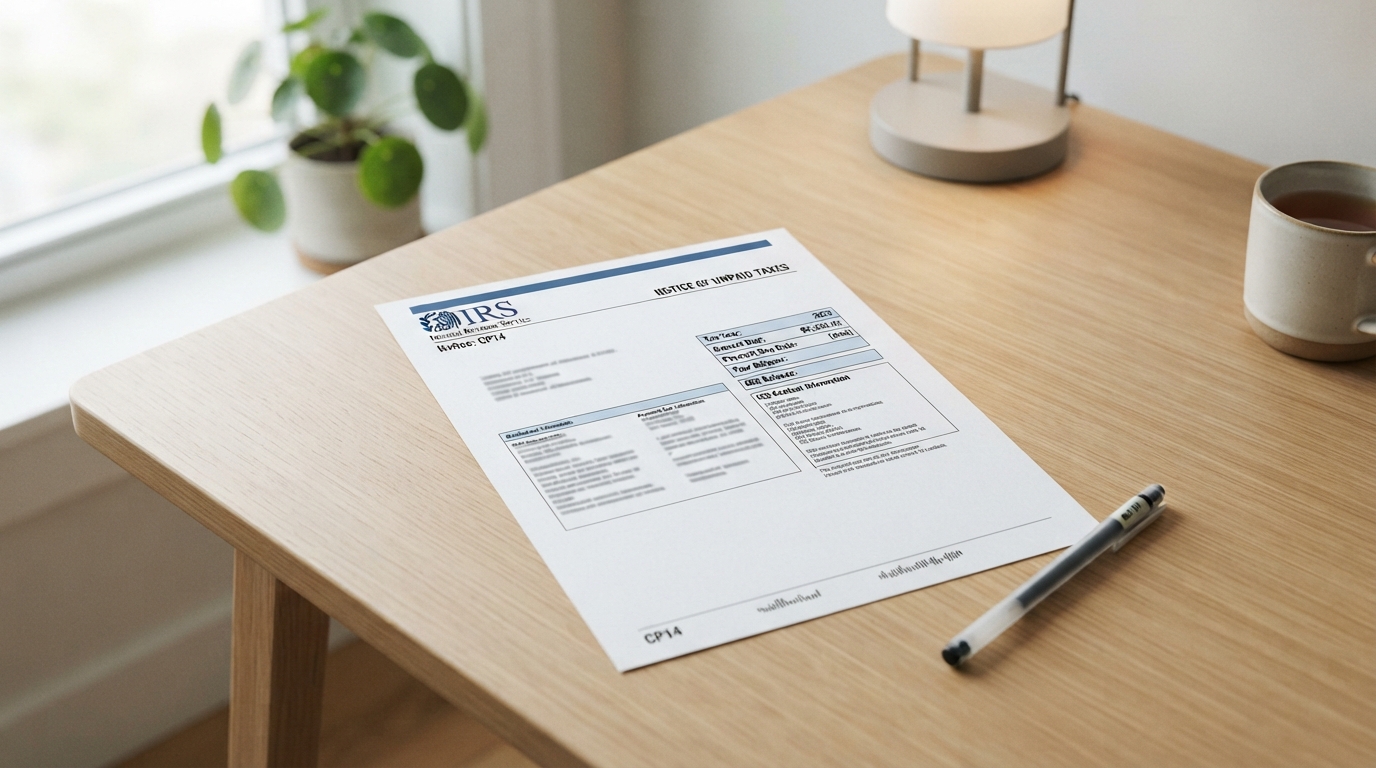
A CP14 is the IRS's first written notice of a balance due on your account. It is a bill, not a levy or lien notice, and it is the earliest point in a longer sequence of collection letters. You typically have several weeks to pay or respond before any further action is taken.
If an envelope from the IRS just arrived and it says you owe money, the first thing worth knowing is this: you're not the first person to feel this way about it, and it's more common than most people realize. A CP14 notice lands in millions of mailboxes every year. It doesn't mean you did something wrong, and it doesn't mean the situation is out of hand. It means the IRS's records show a balance, and it's telling you before it does anything else.
# You're not the first person to open this letter and feel your stomach drop
That distinction — telling you versus acting against you — matters more than almost anything else in this letter. A CP14 is the first step in a process, and where you are in that process determines what's still available to you.
You can confirm you're looking at a CP14 by finding the notice number, usually printed in the top or bottom right-hand corner of the letter. If it says CP14, you're at the very first stage of the sequence — which is meaningfully different from being three or four letters into it.
# What a CP14 notice actually is
A CP14 is the IRS's first written notice of a balance due on your account. It's sent after a return has been filed or processed and the IRS's records show tax owed that hasn't been paid in full. It is not a threat of immediate collection action, and it is not, by itself, evidence of an audit or a dispute about what you filed.
Critical CPA Takeaway
The number in the top or bottom corner of the letter is the notice number. Confirming it says "CP14" is the fastest way to know exactly where you stand in the IRS collection sequence.
Facing This Exact IRS Situation?
Don't speak with an automated call center or non-licensed salesperson. Speak directly with Katherine M. Johnson, CPA, CTRS.
# Why you got one
A CP14 usually shows up for one of a few reasons: a return was filed showing tax owed that wasn't paid with it, an underpayment was identified during processing, or a payment that was sent didn't fully cover what was assessed. Sometimes the amount matches what you expected. Sometimes it doesn't, because penalties and interest have already started accruing on the unpaid portion.
Either way, the letter itself will show the amount, the tax year it relates to, and a breakdown of what's tax versus penalty versus interest. That breakdown is worth reading closely — penalty relief is frequently available and frequently overlooked, and it's often the fastest real reduction in what you owe.
# What the deadline actually is
Your notice has a specific date on it, and that date is the one that governs your situation — not a rule of thumb from an article, including this one. In most cases it gives you a real window, typically measured in weeks rather than days, to pay the balance or respond. That's meaningfully different from the final notice later in the sequence, which carries a hard, non-negotiable deadline tied to your legal appeal rights.
The distinction that matters: a CP14 is a bill. A later notice in the same sequence — the Final Notice of Intent to Levy — is the one that starts a strict legal clock. Confusing the two in either direction causes problems: treating a CP14 as harmless leads people to set it aside, and treating it with the panic appropriate to the final notice can push someone into a decision they didn't need to make yet.
# What happens if you ignore it
Nothing happens immediately, which is exactly what makes this notice easy to set aside — and exactly why setting it aside is the wrong move. A CP14 that goes unanswered doesn't disappear. It's followed by a series of increasingly urgent reminder notices, and if none of those get a response either, the account eventually moves toward more serious collection action: a levy on wages or bank accounts, or a lien filed against your property.
- Stage 1 — CP14: First notice of a balance due. This is where you are now.
- Stage 2 — CP501 → CP503: Reminder notices, escalating in tone.
- Stage 3 — CP504: Notice of Intent to Levy. The IRS states it may levy your state tax refund and pursue other assets.
- Stage 4 — LT11 / Letter 1058: Final Notice of Intent to Levy. Carries your right to a Collection Due Process hearing and a firm 30-day deadline.
- Stage 5 — Levy issued; lien may be filed.
Critical CPA Takeaway
Every letter after this one gets harder to work with, not because the IRS is punishing you for waiting, but because your options genuinely narrow as the case moves along. The most useful thing you can do with a CP14 is treat it as the easiest point in the sequence to act from — because it is.
# Your options right now
Pay it, if you can. If the amount is accurate and manageable, paying resolves it outright and stops everything downstream.
Set up a payment plan. If you can't pay in full, an installment agreement is often available and can often be arranged without a full financial disclosure, depending on the balance.
Ask whether the amount is right. If something doesn't match what you expected — a return you didn't file, income that isn't yours, a penalty you think shouldn't apply — that's worth raising before you pay, not after.
Find out if you actually qualify for a reduction. Between penalty relief, an Offer in Compromise, and Currently Not Collectible status, there may be a real, honest path to owing less than the notice states — but which one applies depends entirely on your numbers, not on the letter itself.
Get someone to look at the whole picture, especially if this notice arrived alongside others, or if there are unfiled years sitting behind it. A CP14 is sometimes the visible part of a larger situation.
# Common mistakes people make with this letter
Assuming it's a scam and throwing it away. The IRS does contact taxpayers by mail, and a CP14 is a normal part of that process. It's worth confirming it's genuine — the IRS won't demand payment by gift card or wire transfer, and it will always give you a way to verify the notice — but dismissing a real notice as fake is one of the more expensive mistakes in this category.
Setting it aside because the deadline feels far off. It's real time, but it isn't unlimited time, and the notices that follow don't get easier to deal with.
Paying immediately without checking the numbers. If the amount is wrong, paying it doesn't fix the underlying issue — it just means you've paid an incorrect balance and now have to seek a correction after the fact.
Trying to negotiate over the phone before pulling your transcripts. What your account actually shows — every year, every notice, every prior action — is the real picture. A phone call without that information in front of you is a conversation happening in the dark.
# Why this notice feels bigger than it is
Most people who call about a CP14 have spent more time worrying about it than the letter itself warrants — not because the balance isn't real, but because the not-knowing is worse than the knowing. Once someone understands exactly where they are in the sequence and what their real options are, the letter usually stops being the thing keeping them up at night.
That's not a minimization of the problem. It's just accurate: this is the easiest point in the process to be standing at, and it's worth treating it that way.
Frequently Asked Questions (FAQ)
Q: What is a CP14 notice?
It's the IRS's first written notice that your account shows a balance due. It's a bill, not a levy notice, and it's the earliest point in a longer sequence of collection letters.
Q: Is this letter real, or could it be a scam?
The IRS contacts taxpayers by mail as a matter of routine, and a CP14 is a standard notice. It will never demand payment by gift card, wire transfer, or over the phone on the spot. If you're unsure, you can verify your notice number and balance through your IRS online account rather than calling a number printed in an email or text claiming to be the IRS.
Q: Where do I find the notice number on my letter?
Usually in the top or bottom right-hand corner. Confirming it reads "CP14" tells you exactly where you are in the process.
Q: What happens if I do nothing?
The account moves toward a series of increasingly serious notices, ending in a levy or lien if it goes unaddressed long enough. Nothing about that sequence resolves on its own.
Q: Can I set up a payment plan directly from this notice?
Often, yes, depending on the balance and your filing history. A payment plan is frequently the most straightforward path, and it's worth exploring before assuming a larger resolution is necessary.
Q: Should I call the IRS myself first?
You can. What matters most is going in with your actual account information — your transcripts — rather than the notice alone, since the notice is a snapshot and the transcript is the full picture.
Summary & Next Steps
A CP14 is the easiest point in this process to act from. Call (800) 236-3741, or book a time that works for you, and we'll tell you plainly where you stand and what your real options are. This is general information, not tax advice for your specific situation. Next Level Tax Resolution, Inc. is not affiliated with or endorsed by the IRS. Penalties and interest continue to accrue on unpaid balances until resolved.
Katherine M. Johnson, CPA, CTRS
Katherine M. Johnson is a licensed CPA with over 30 years of experience and a Certified Tax Resolution Specialist (CTRS). She personally handles every case — representing individuals and businesses before the IRS and state revenue departments nationwide.
Related Guides & Articles
When an IRS Revenue Officer Visits Your Business: What You Should and Shouldn't Do
Revenue Officers are field enforcement agents assigned to high-dollar or payroll tax cases. Learn your rights when an officer makes contact.
How to Stop Wage Garnishment and Regain Your Paycheck
Receiving an IRS wage garnishment can leave you with very little to cover living expenses. Learn how IRS wage levies work, exemption rules, and how a CPA can release the garnishment.
Tax Lien Release vs. Withdrawal vs. Subordination vs. Discharge: Which Do You Need?
Refinancing a home or selling property with a federal tax lien? Learn which of the four lien remedies applies to your situation so you don't lose weeks at closing.