
Can You Qualify for Estimated Tax Penalty Relief?
Safe harbors, the annualized income method, disaster waivers, and the retirement/disability exception — how estimated tax penalty relief actually works under IRC § 6654.

Katherine M. Johnson, CPA, CTRS
Lead Tax Resolution CPA
Estimated tax penalty relief is available under IRC § 6654 through four paths: (1) meeting a safe harbor — owing under $1,000, paying 90% of the current-year tax, or paying 100% of the prior-year tax (110% if AGI exceeded $150,000); (2) the annualized income installment method on Form 2210 Schedule AI, which aligns required payments with when income was actually earned; (3) a statutory waiver for casualty, disaster, or unusual circumstance under § 6654(e)(3)(A); or (4) the retirement/disability reasonable-cause exception under § 6654(e)(3)(B) for taxpayers who retired after age 62 or became disabled. First-Time Penalty Abatement (FTA) does not apply to estimated tax penalties — they are statutory interest charges, not the discretionary penalties FTA covers.
The federal tax system runs on a pay-as-you-go basis: under IRC § 6654 for individuals and § 6655 for corporations, you are expected to pay tax as income is earned, not only at year-end. When income is not subject to wage withholding — 1099 work, business profits, dividends, capital gains, or rent — quarterly estimated payments are how you stay current. Fall short across those quarterly windows and the IRS assesses an addition to tax commonly called the estimated tax penalty, calculated as a daily interest charge on each underpaid installment. The good news is that the code builds in statutory safe harbors and specific waiver grounds, and understanding them before you file is what turns an avoidable penalty into a non-event.
# Understanding the IRS estimated tax penalty and safe harbor rules
Under IRC § 6654 for individuals, estates, and trusts, and § 6655 for corporations, taxpayers must pay tax on income as it is earned throughout the year. If you receive income that is not subject to regular wage withholding — such as 1099 independent contractor earnings, small business profits, dividends, interest, capital gains, or rental activity — you are required to submit quarterly estimated tax payments.
For individuals, these payments fall into four installment windows: April 15 (covering January 1 through March 31), June 15 (covering April 1 through May 31), September 15 (covering June 1 through August 31), and January 15 of the following tax year (covering September 1 through December 31). When you do not pay enough across these windows, the IRS assesses an addition to tax — the estimated tax penalty — calculated per day on the unpaid amount from each quarterly due date until paid or April 15.
The code offers statutory protections called safe harbors. You can avoid the underpayment penalty entirely if your payments satisfy any of these conditions.

- The $1,000 threshold: you owe less than $1,000 in total tax on your return after subtracting wage withholdings and allowable tax credits.
- The 90% current-year safe harbor: your total timely payments and withholdings equal at least 90% of your total tax liability for the current tax year.
- The 100% prior-year safe harbor: your payments equal 100% of the total tax shown on your return for the preceding 12-month tax year (assuming you filed a return with a tax liability).
- The high-income 110% safe harbor: if your AGI on the prior year's return exceeded $150,000 (or $75,000 if married filing separately), the prior-year safe harbor percentage increases to 110%.
- Farmers and fishermen: a 66 ⅔% current-year safe harbor applies under special rules in § 6654(i).
Critical CPA Takeaway
Safe harbors are the cleanest defense against an estimated tax penalty — if you met one, the penalty should not have been assessed at all. The annualized income method is the next line of defense when your income was not earned evenly across the year.
# The annualized income installment method (Schedule AI)
The standard IRS penalty calculation assumes you earned income evenly throughout the calendar year, requiring four equal quarterly payments of 25% each. For seasonal business owners, real estate agents, independent consultants, or investors realizing a fourth-quarter capital gain, that assumption can produce an unfair penalty on earlier quarters when income was lower.
Form 2210 Schedule AI (Annualized Income Installment Method) lets you calculate the required payment for each installment based on your actual income and deductions for that specific period. By completing Schedule AI, you align your required quarterly payment with when you actually earned the revenue, reducing or eliminating penalties for the first, second, or third quarters.
- Period 1 (Jan 1 – Mar 31): income annualized over 12 months (multiplied by 4).
- Period 2 (Jan 1 – May 31): income annualized over 12 months (multiplied by 2.4).
- Period 3 (Jan 1 – Aug 31): income annualized over 12 months (multiplied by 1.5).
- Period 4 (Jan 1 – Dec 31): actual income for the full year (multiplied by 1).
Facing This Exact IRS Situation?
Don't speak with an automated call center or non-licensed salesperson. Speak directly with Katherine M. Johnson, CPA, CTRS.
# Statutory grounds and qualifications for estimated tax penalty relief
Unlike failure-to-file or failure-to-pay penalties, which allow general administrative discretion, estimated tax penalty relief is governed strictly by the statutory rules in IRC § 6654(e)(3). Under § 6654(e)(3)(A), the IRS can waive the penalty if the underpayment was caused by a casualty, natural disaster, or other unusual circumstance, and imposing the penalty would be against equity and good conscience.
When the President issues a major disaster declaration, the IRS automatically issues § 7508A postponements for affected counties and parishes, extending estimated tax deadlines without requiring taxpayers to file special waiver forms. The IRS processes these statutory adjustments under IRM 20.1.3, Estimated Tax Penalties.
Under § 6654(e)(3)(B), the IRS can also waive underpayment penalties under a specific statutory reasonable cause exception for newly retired or disabled taxpayers. To qualify, you must meet three criteria: you retired after reaching age 62, or you became disabled; the retirement or disability occurred during the tax year for which the estimated payments were required, or in the immediately preceding tax year; and the underpayment was due to reasonable cause and not willful neglect. This rule accounts for the transitional confusion of moving from W-2 wage withholding to retirement distributions, pensions, or disability benefits. Learn more about how we establish these grounds in our guide to reasonable cause penalty relief.
Critical CPA Takeaway
The retirement/disability waiver is narrow and statutory, not discretionary. It applies only to the tax year the retirement or disability occurred (or the immediately preceding year) — not to every year afterward.
# How farmers and fishermen secure estimated tax penalty relief
Agricultural workers and commercial fishermen operate under unique seasonal cash flow cycles, so the tax code provides special rules under IRC § 6654(i).
When administrative issues delay filing season forms, the IRS has issued blanket waivers. For example, the IRS has granted automatic waivers of § 6654 additions for qualifying farmers and fishermen when their return was filed and paid in full by April 15, due to software updates affecting certain forms. These blanket notices let affected taxpayers obtain full abatement without proving individual hardship.
- The two-thirds gross income rule: at least 66 ⅔% of your total gross income must be derived from farming or fishing in either the current tax year or the preceding tax year.
- Single payment option: qualifying farmers and fishermen need only make one annual estimated payment of 66 ⅔% of the current year's tax (or 100% of the prior year's tax) by January 15.
- March 1 filing exception: if you file your full return (Form 1040) and pay all tax due by March 1 following the close of the tax year, you avoid estimated tax penalties entirely.
# Administrative waivers vs. reasonable cause: what truly applies
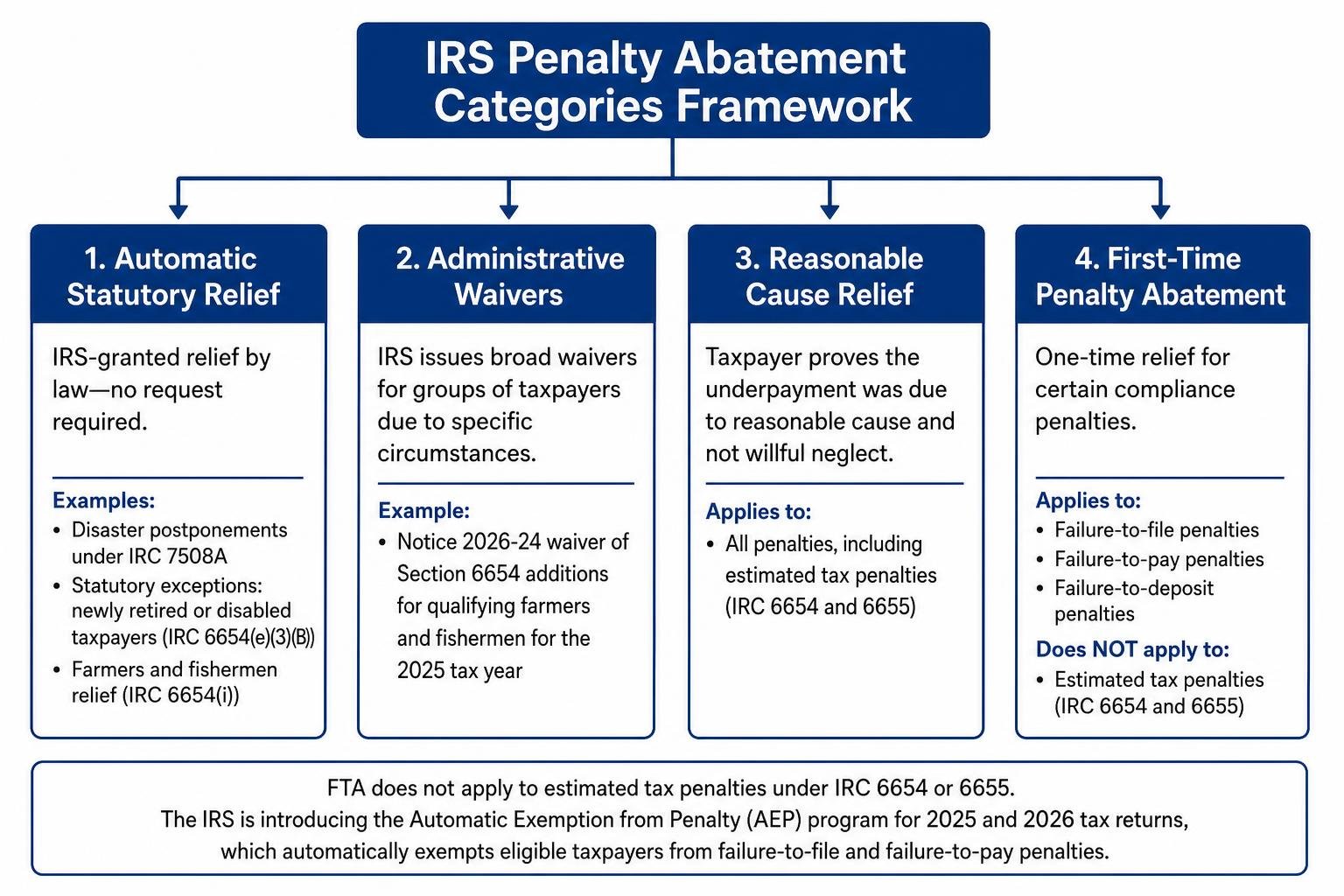
There is widespread confusion about how administrative relief applies to estimated tax penalties. A common mistake is assuming that First-Time Penalty Abatement (FTA) can remove an estimated tax penalty. FTA does not apply to estimated tax penalties under § 6654 or § 6655 — administrative FTA relief is legally restricted to failure-to-file, failure-to-pay, and failure-to-deposit penalties. See how FTA operates for other assessed penalties in our breakdown of first-time penalty abatement.
The IRS is transitioning its administrative relief processes by introducing the Automatic Exemption from Penalty (AEP) program for recent tax returns. AEP will automatically exempt eligible taxpayers with a 3-year clean compliance history from failure-to-file and failure-to-pay penalties during initial processing. However, because estimated tax penalties are statutory interest charges under § 6654, they are excluded from AEP. Having an estimated tax penalty on your transcript does not disqualify you from receiving FTA or AEP on other tax penalties, as outlined in official IRS guidance on administrative penalty relief.
When retroactive legislative amendments significantly alter how tax liability is calculated, the IRS can invoke § 6654(e)(3)(A) to issue blanket penalty waivers on equity and good conscience grounds. Following retroactive CARES Act modifications to excess business loss limitations, the IRS allowed affected individual taxpayers to recalculate their estimated tax obligations by subtracting a Taxable Income Reduction Amount on Form 2210. These administrative notices allow taxpayers penalized by retroactive rule changes to obtain full abatement without proving individual hardship.
Critical CPA Takeaway
If your only penalty is an estimated tax underpayment charge, FTA and AEP will not touch it. Relief has to come from a safe harbor, Schedule AI, a statutory waiver, or a blanket IRS notice — each of which requires its own documentation.
# Step-by-step: how to request estimated tax penalty relief
If the IRS assesses an underpayment penalty, you can review, recalculate, and dispute the addition. In a recent fiscal year, the IRS assessed tens of billions in civil penalties and abated the majority of assessed penalty dollars through proper administrative and statutory channels — meaning most penalty dollars are successfully removed when the right grounds are documented.
When reviewing your account transcript, you may see Transaction Code (TC) 176 for a computer-generated penalty assessment, TC 170 for a manual or self-assessed penalty, or TC 171 / 177 for a manual or computer penalty abatement. To pursue penalty abatement, follow the procedural steps below.
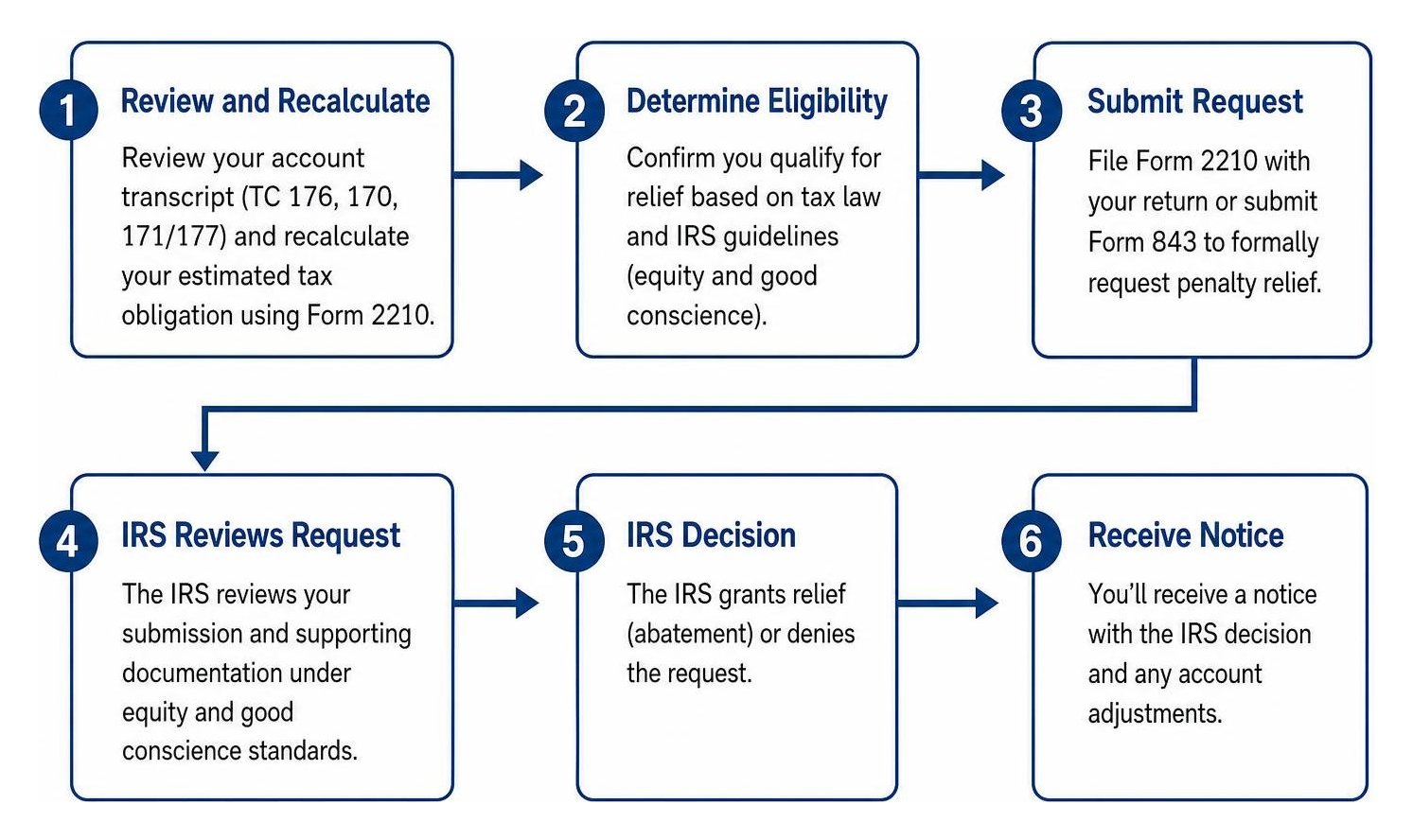

- Obtain Form 2210 and complete Part I to calculate your baseline required annual payment.
- Select your waiver category in Part II: Box A to request a waiver using Schedule AI (annualized income), or Box B to request a waiver of the entire penalty based on casualty, disaster, unusual circumstance, or retirement/disability with reasonable cause.
- Attach a signed written statement explaining why you were unable to make timely estimated payments, noting the specific quarter dates affected and the underlying event.
- Include supporting evidence: medical documentation, disability letters, FEMA disaster documentation, casualty loss police or insurance reports, or documentation of age 62+ retirement.
Critical CPA Takeaway
If you already paid the penalty, file Form 843 (Claim for Refund and Request for Abatement) within three years from the date the return was filed or two years from the date the penalty was paid, whichever is later. Enter § 6654 on Line 6, check 'Other reason allowed under the law' on Line 7c, and reference any applicable IRS notice on Line 8.
# What to do if your penalty abatement request is denied
If the IRS rejects your request for estimated tax penalty relief, you will receive a formal denial letter (such as Letter 854C or Letter 852c). You have several formal options to challenge the decision.
For details on administrative rights and dispute escalation, review the official guidance on penalty relief for reasonable cause. If you are dealing with broader tax debts alongside penalties, see how relief programs work in our guide to understanding the IRS Fresh Start Program.
- IRS Independent Office of Appeals: you have the right to appeal within 30 calendar days of the denial letter, with a written protest explaining the factual and legal reasons the IRS determination is incorrect, supported by copies of your Form 2210, returns, and third-party evidence.
- Collection Due Process (CDP) hearing: if the IRS attempts enforcement (such as a Notice of Intent to Levy) to collect the assessed penalty, you can file Form 12153 within 30 days to request a CDP hearing with an independent Appeals Officer.
- U.S. Tax Court or federal court: if administrative appeals do not resolve the issue, statutory disputes can be escalated to the United States Tax Court, the U.S. Court of Federal Claims, or the appropriate U.S. District Court.
Frequently Asked Questions (FAQ)
Q: Does First-Time Penalty Abatement (FTA) apply to estimated tax penalties?
No. Standard First-Time Penalty Abatement applies solely to failure-to-file (§ 6651(a)(1)), failure-to-pay (§ 6651(a)(2)), and failure-to-deposit (§ 6656) penalties. Estimated tax penalties under § 6654 and § 6655 are governed strictly by statutory exceptions — safe harbors, disaster waivers, the annualized income method, or retirement/disability reasonable cause — and cannot be removed through the FTA administrative waiver program.
Q: Does the IRS automatically remove interest when an estimated tax penalty is waived?
Yes. Under § 6404, interest charges are tied directly to underlying tax and penalty liabilities. When the IRS abates or reduces an estimated tax underpayment penalty, any compounding interest accrued specifically on that abated penalty amount is automatically removed from your account transcript.
Q: How does entering an IRS payment plan impact underpayment penalties?
An installment agreement lets you pay existing tax balances over time while avoiding aggressive enforcement like bank levies or wage garnishments. While a formal agreement cuts the ongoing failure-to-pay penalty rate in half (from 0.5% to 0.25% per month), it does not retroactively eliminate estimated tax penalties that accrued during prior tax years. Maintaining current quarterly estimated payments is an explicit compliance requirement of every IRS installment agreement.
Q: What is the annualized income installment method on Form 2210?
Schedule AI of Form 2210 lets you calculate each quarterly required payment based on the income you actually earned in that period, rather than assuming equal income across all four quarters. It reduces or eliminates penalties for taxpayers with seasonal or uneven income — real estate agents, consultants, or investors with a late-year capital gain — by matching the required payment to when the revenue was realized.
Summary & Next Steps
Navigating IRS underpayment penalties requires understanding the strict statutory lines drawn by the Internal Revenue Code. Because estimated tax penalty relief cannot be handled through standard administrative first-time forgiveness, securing relief demands precise calculation, proper application of safe harbors, Schedule AI annualization, or clear documentation of statutory exceptions like disasters, disability, or retirement. At Next Level Tax Resolution, Inc., we bring more than 20 years of direct IRS negotiation experience to evaluate your tax transcripts, determine statutory eligibility, and prepare detailed abatement submissions. If you have received an IRS penalty notice or need help structuring compliant quarterly payments, explore our penalty abatement services and review structured relief options like IRS payment plans to protect your financial standing. This is general information, not tax advice for your specific situation. Next Level Tax Resolution, Inc. is not affiliated with or endorsed by the IRS. Individual outcomes vary and are not guaranteed.
Katherine M. Johnson, CPA, CTRS
Katherine M. Johnson is a licensed CPA with over 30 years of experience and a Certified Tax Resolution Specialist (CTRS). She personally handles every case — representing individuals and businesses before the IRS and state revenue departments nationwide.
Related Guides & Articles
Can You Buy a House or Qualify for a Mortgage When You Owe Back Taxes?
Underwriters ask for tax transcripts and proof of filing. Learn how setting up a documented installment agreement clears the path to mortgage approval.
Smart Tax Planning Strategies to Minimize Stress and Maximize Savings
Effective tax planning is a proactive process that helps individuals and business owners make informed financial decisions throughout the year instead of scrambling when filing deadlines approach.
Substitute for Return (SFR): Why the IRS's Number Is Almost Always Too High
When you don't file, the IRS files an SFR on your behalf using 1099s/W-2s — with ZERO deductions or exemptions. Learn how preparing an original return reduces or eliminates that balance.